
A Technical Guide on How to Get SOC 2 Certification
 By opsmoon
Learn how to get SOC 2 certification with this technical guide. We cover scoping, control implementation, auditor selection, and maintaining compliance.
Getting your SOC 2 certification is a rigorous engineering undertaking, but it's a non-negotiable requirement for any B2B SaaS company handling customer data. Treat it less like a compliance checkbox and more as a verifiable trust signal in a competitive market. For engineering and security teams, this journey transcends policy documents and dives deep into the technical architecture and operational security of your systems.
The demand for this level of assurance is growing exponentially. The market for SOC reporting services reached USD 5,392 million in 2024 and is projected to nearly double by 2030, a clear indicator of its critical importance. For detailed data, Sprinto offers valuable insights on the SOC reporting market.
This guide is a technical, actionable roadmap. We’ll deconstruct the strategic decisions required upfront to ensure a streamlined and successful audit engagement.
We'll cover:
- Audit Scoping: How to select the right Trust Services Criteria (TSC) based on your service commitments and system architecture.
- Report Selection: The technical and business implications of choosing a Type I vs. a Type II report.
- Technical Implementation: Concrete, actionable steps for implementing and evidencing your security posture using modern DevOps practices.
The entire process hinges on a few critical decisions made at the outset.
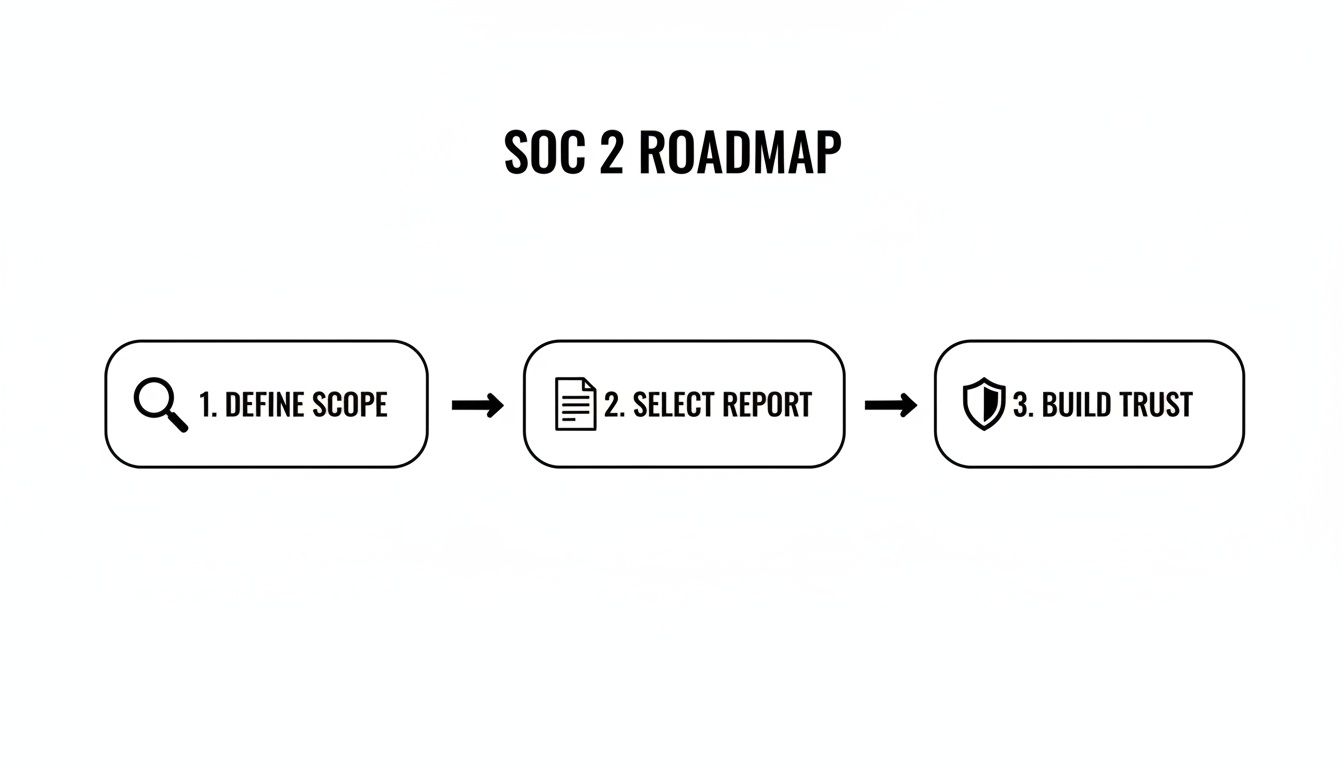
As illustrated, building verifiable trust is the objective. This starts with a meticulous definition of your audit scope and selecting the appropriate report type. Correctly architecting these foundational components will prevent significant technical debt and costly remediation down the line.
Defining Your Scope and Conducting a Gap Analysis
Before writing a single policy or configuring a new security control, you must define the audit's precise boundaries. For SOC 2, this is a technical exercise, not a formality. Mis-scoping can lead to wasted engineering cycles, inflated audit costs, and a final report that fails to meet customer requirements.
Your primary objective is to produce a "system description" that provides the auditor with an unambiguous, technically detailed view of the in-scope systems, data flows, and personnel.
The process begins with selecting the applicable Trust Services Criteria (TSCs). Security is the mandatory, non-negotiable foundation for every SOC 2 report, often referred to as the Common Criteria. This TSC covers fundamental controls such as logical and physical access, system operations, change management, and risk mitigation.
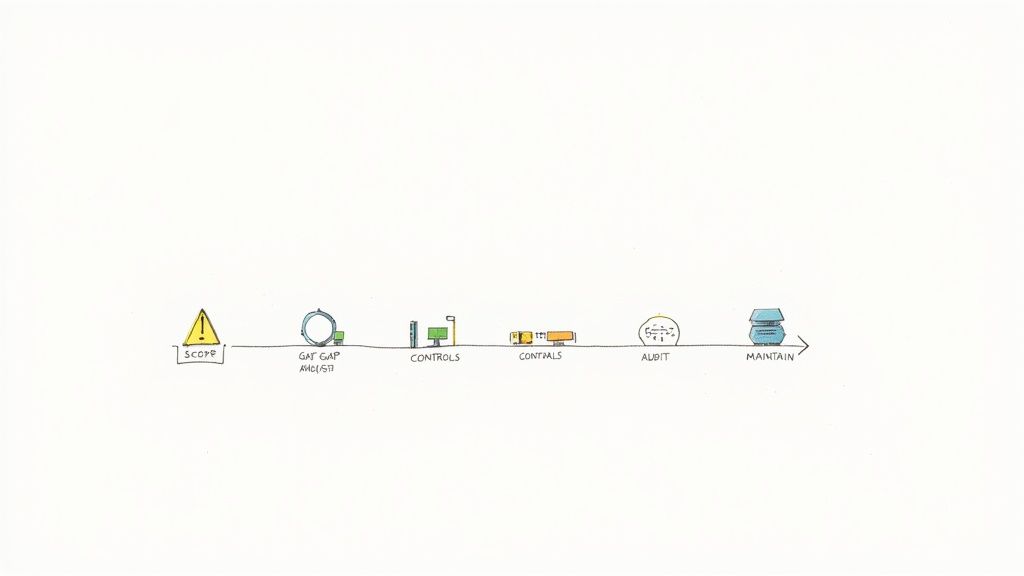
Choosing Your Trust Services Criteria
Beyond the Security TSC, you must select additional criteria only if they align with explicit or implicit commitments made to your customers. Avoid the temptation to over-scope by adding all TSCs; this exponentially increases the audit's complexity, evidence requirements, and cost.
Make your selection based on technical function and service level agreements (SLAs):
- Availability: Is a specific uptime percentage guaranteed in your customer contracts (e.g., 99.9% uptime)? If your platform's downtime results in financial or operational impact for customers, this TSC is mandatory. Think load balancers, auto-scaling groups, and disaster recovery plans.
- Processing Integrity: Does your service perform critical computations or transactions? Examples include financial transaction processing, data analytics platforms, or e-commerce order fulfillment. This TSC focuses on the completeness, validity, accuracy, and timeliness of data processing.
- Confidentiality: Do you handle sensitive, non-public data that is protected by non-disclosure agreements (NDAs) or other contractual obligations? This includes intellectual property, M&A data, or proprietary algorithms. Key controls include data encryption (in transit and at rest) and strict access controls.
- Privacy: This criterion applies specifically to the handling of Personally Identifiable Information (PII) and is distinct from Confidentiality. It aligns with privacy frameworks like GDPR and CCPA, covering how PII is collected, used, retained, disclosed, and disposed of. If you process user data, Privacy is almost certainly required.
Once you've finalized your TSCs, map them to the specific components of your service architecture. This includes your production infrastructure (e.g., specific AWS VPCs, GCP Projects, Kubernetes clusters), the applications and microservices involved, the databases and data stores, and the key personnel and third-party vendors with system access. This mapping defines your formal audit boundary.
Executing a Technical Gap Analysis
With a defined scope, execute a rigorous, control-level gap analysis. This involves comparing your current security posture against the specific points of focus within your chosen TSCs. Adopting a modern compliance risk management framework is essential for structuring this analysis and clearly defining the audit boundaries.
This analysis requires creating a detailed control inventory, typically within a GRC tool or a version-controlled spreadsheet, mapping every applicable SOC 2 criterion to your existing technical implementation.
Technical Note: Treat the gap analysis as a pre-audit simulation. Be ruthlessly objective. A gap identified internally is a JIRA ticket; a gap identified by your auditor is a qualified opinion or an "exception" in your final report, which can be a deal-breaker for customers.
For example, when evaluating CC6.2 (related to user access), you must document the exact technical mechanisms for identity and access management.
- How are IAM roles and permissions provisioned? Is it automated via an IdP like Okta using SCIM, or a manual process?
- How do you enforce the principle of least privilege in your cloud environment (e.g., AWS IAM policies)?
- What is the mean time to de-provision access upon employee termination? Is this process automated via API hooks into your HRIS?
If the answer to any of these is "ad-hoc," you've identified a gap. Remediation requires not just a written policy but an implemented technical control, such as an automated de-provisioning script triggered by your HR system's offboarding webhook.
The output of your gap analysis is a prioritized backlog of remediation tasks. This backlog becomes your technical roadmap to compliance. To gain a deeper understanding of auditor expectations, review the detailed SOC 2 requirements. This technical backlog is your execution plan for entering the formal audit with a high degree of confidence.
With your gap analysis complete and a prioritized remediation backlog, it's time for implementation. This is where you translate abstract policies into tangible, automated controls within your cloud and DevOps workflows.
For a modern technology company, SOC 2 compliance is not achieved through manual checklists. It's about engineering security into the core of your infrastructure and software delivery lifecycle (SDLC).
The primary objective is to build systems that are auditable by design. This means the evidence required for an audit is a natural, immutable byproduct of standard engineering operations, rather than something that must be manually gathered later. Your most critical tool in this endeavor is Infrastructure as Code (IaC).
Codifying Security with Infrastructure as Code
Infrastructure as Code (IaC) is the practice of managing and provisioning your entire infrastructure through machine-readable definition files, using tools like Terraform, CloudFormation, or Pulumi.
For SOC 2, IaC is a transformative technology. It converts abstract security policies into concrete, version-controlled, and peer-reviewed code artifacts.
Consider a fundamental SOC 2 control: network access restriction (part of the Security TSC). The legacy approach involved manual configuration of firewall rules through a cloud console—a process prone to human error and difficult to audit. With IaC, these rules are defined declaratively in code.
# Example Terraform code for a restrictive AWS security group
resource "aws_security_group" "web_server_sg" {
  name        = "web-server-security-group"
  description = "Allow inbound TLS traffic"
  vpc_id      = aws_vpc.main.id

  ingress {
    description = "HTTPS from anywhere"
    from_port   = 443
    to_port     = 443
    protocol    = "tcp"
    cidr_blocks = ["0.0.0.0/0"]
  }

  egress {
    from_port   = 0
    to_port     = 0
    protocol    = "-1"
    cidr_blocks = ["0.0.0.0/0"]
  }

  tags = {
    Owner = "security-team"
    SOC2-Control = "CC6.6"
  }
}
This code block becomes immutable, auditable evidence. It demonstrates precisely how network controls are enforced. Any proposed change must be submitted as a pull request, reviewed by a qualified peer, and is automatically logged in the Git history. This provides a complete, verifiable audit trail for change management. You can learn more about how to check IaC security to ensure configurations are secure from inception.
Integrating Security into CI/CD Pipelines
Your CI/CD pipeline is the automated pathway for deploying code to production. It is the ideal chokepoint for enforcing security controls and identifying vulnerabilities early in the development lifecycle (a practice known as "shifting left").
This DevSecOps approach embeds security directly into the engineering workflow.
Here are specific, actionable controls to integrate into your pipeline for SOC 2:
- Static Application Security Testing (SAST): Integrate tools like Snyk or Veracode to scan source code for vulnerabilities (e.g., SQL injection, XSS) on every commit.
- Software Composition Analysis (SCA): Use tools like Dependabot or OWASP Dependency-Check to scan open-source dependencies for known CVEs. Supply chain security is a major focus for auditors.
- Secret Scanning: A non-negotiable control is implementing GitHub Secret Scanning or a similar tool. This prevents the accidental commit of secrets like API keys and database credentials by automatically blocking any pull request containing them.
- IaC Policy Enforcement: Before applying any Terraform or CloudFormation changes, use policy-as-code tools like Open Policy Agent (OPA) or Checkov to scan the code for misconfigurations (e.g., publicly exposed S3 buckets, unrestricted security groups).
By building these automated gates into your pipeline, you create a system that programmatically enforces security policies, providing auditors with a wealth of evidence demonstrating secure development practices.
Enforcing Least Privilege with RBAC
Identity and Access Management (IAM) is a cornerstone of any SOC 2 audit. Auditors will rigorously examine how you manage access, focusing on the principle of least privilege: users and systems should only have the minimum permissions necessary to perform their functions.
Role-Based Access Control (RBAC) is the standard mechanism for implementing this principle. Instead of assigning permissions to individual users, you define roles with specific permission sets (e.g., "ReadOnlyDeveloper," "DatabaseAdmin," "Auditor") and assign users to these roles.
Key Takeaway: Your IAM strategy must be declarative and auditable. Define your RBAC policies as code using your IaC tool. This simplifies access reviews; you can point an auditor to a Git repository containing the canonical definition of all roles and permissions.
For instance, you can define a Terraform IAM role that grants read-only access to specific S3 buckets for debugging purposes, preventing developers from being able to modify or delete production data. This programmatic approach eliminates manual permission drift and establishes a single source of truth for access control.
Establishing Comprehensive Logging and Monitoring
Effective security requires comprehensive visibility. A critical component of SOC 2 is demonstrating robust logging and monitoring to detect and respond to security incidents.
Your implementation plan must address multiple layers of telemetry:
- Infrastructure Logging: Enable and configure native cloud provider logging services like AWS CloudTrail or Azure Monitor to capture every API call within your environment.
- Application Logging: Instrument your applications to produce structured logs (e.g., JSON format) for key security events, such as user authentication attempts, permission changes, and access to sensitive data.
- Centralized Log Aggregation: Ingest logs from all sources into a centralized Security Information and Event Management (SIEM) system like an ELK stack, Datadog, or Splunk. Centralization is essential for effective incident correlation and investigation.
Once logs are centralized, you must implement automated monitoring and alerting. Use tools like Prometheus for metrics and Grafana for dashboards to configure alerts for anomalous activity. An auditor will expect to see evidence of alerts for events such as multiple failed login attempts from a single IP address or unauthorized API calls, proving your incident response plan is an active, automated system.
Automating Evidence Collection and Selecting an Auditor
You've engineered and deployed your technical controls. Now, your focus shifts from implementation to demonstration. An auditor will not simply accept that your systems are secure; they require verifiable, objective evidence for every single control in scope. This phase demands a systematic and, ideally, automated approach to evidence collection.
Attempting to gather this evidence manually is an inefficient, error-prone process. The manual collection of user access lists, system configuration screenshots, change management tickets, and security scan reports is a direct path to audit fatigue and failure.
Streamlining with Automation and GRC Platforms
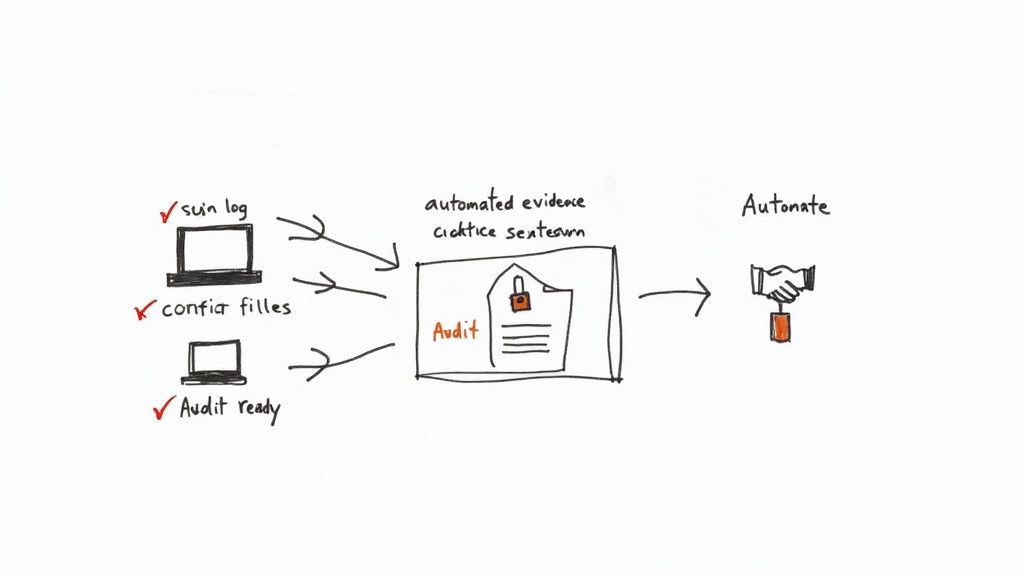
The only scalable method is to automate evidence collection. This strategy is not merely about convenience; it's about creating a continuously auditable system where evidence generation is an inherent function of your operational processes.
Governance, Risk, and Compliance (GRC) platforms are designed for this purpose. They integrate directly with your technology stack via APIs—connecting to your cloud provider (AWS, GCP, Azure), source control (GitHub, GitLab), and IdP (Okta, Azure AD)—to automatically collect and organize evidence.
Consider these practical examples of automated evidence collection:
- Quarterly Access Reviews: A GRC tool can connect to your cloud provider's IAM service, automatically generate a list of all users with access to production environments, create tickets in Jira or Slack for the designated system owners to review, and record the timestamped approval as evidence.
- Vulnerability Scans: Your CI/CD pipeline's vulnerability scanner (e.g., Snyk) can be configured via API to push scan results directly to a central evidence repository, providing an immutable record that every deployment is scanned.
- Infrastructure Changes: By integrating with GitHub, you can automatically collect evidence for every merged pull request that modifies your Terraform code, creating a perfect audit trail for your change management controls.
Your engineering goal should be to transition from a "pull" model of evidence collection (manual requests) to a "push" model (automated, event-driven collection). This transforms audit preparation from a multi-week, high-stress event into a routine, low-friction process.
This automated posture is also critical for meeting the increasing demand for continuous assurance. A single annual report is no longer sufficient for many enterprise customers. According to recent data, 92% of organizations now perform two or more audits annually, with 58% conducting four or more. This trend toward "always-on" auditing makes automation a necessity. More data on this trend can be found at cgcompliance.com.
How to Choose the Right Auditor
Selecting an audit firm is a critical decision. A technically proficient auditor acts as a partner, understanding your architecture and providing valuable guidance. An ill-suited firm can lead to a frustrating and expensive engagement. Crucially, only an AICPA-accredited CPA firm is authorized to issue a SOC 2 report.
Plan to interview a minimum of three to five firms. Your evaluation should prioritize technical competency over cost.
Key Questions to Ask a Potential SOC 2 Auditor
- Describe your experience with our specific technology stack (e.g., Kubernetes, serverless, Terraform). An auditor fluent in modern cloud-native technologies will conduct a more efficient and relevant audit. Request redacted report examples from companies with a similar technical profile.
- Provide the credentials and experience of the specific individuals who will be assigned to our engagement. You need to assess the technical depth of the team performing the fieldwork, not just the sales partner. Inquire about their certifications (CISA, CISSP, AWS/GCP certs) and hands-on experience.
- What is your methodology for evidence collection and communication? Do they use a modern portal with API integrations, or do they rely on email and spreadsheets? A firm that has invested in a streamlined evidence management platform will significantly reduce your team's administrative burden.
- Can you provide references from companies of a similar size and stage? The audit methodology for a large enterprise is often ill-suited for a 50-person startup. Ensure their approach is pragmatic and risk-based, not a rigid, one-size-fits-all checklist.
While core audit procedures are standardized, elements like scope definition, timing, and evidence format are often negotiable. A good partner will work with you to define an audit that is both rigorous and relevant to your specific business context.
Navigating the Audit Process and Timelines
You've implemented controls and automated evidence collection. The next phase is the formal audit engagement, where an independent CPA firm validates the design and operational effectiveness of your controls.
Understanding the audit lifecycle is crucial for managing internal expectations regarding timelines, team involvement, and cost. The process typically includes a readiness assessment, the primary "fieldwork" (testing), and concludes with the issuance of the final SOC 2 report.
Preparing for Auditor Fieldwork
Fieldwork is the most intensive phase of the audit, involving direct testing of your controls. This includes technical interviews, documentation review, system walkthroughs, and formal evidence requests, known as Requests for Information (RFIs).
Your objective is to make this process as efficient as possible.
- Designate a Single Point of Contact (SPOC): Assign one person, typically from the security or engineering team, to manage all communications with the audit team. This prevents miscommunication and ensures RFIs are tracked and resolved systematically.
- Prepare Technical Subject Matter Experts (SMEs): Your engineers will be interviewed about the controls they own. Coach them to provide direct, factual answers limited to their area of expertise. Speculation can lead to unnecessary audit trails.
- Organize Evidence Proactively: Using a GRC platform is ideal. If managing manually, establish a centralized, access-controlled repository (e.g., a secure SharePoint site or Confluence space) for all evidence, organized by control number.
An organized, responsive approach demonstrates a mature security program and builds credibility with the audit team, often expediting the entire process.
Auditor Insight: Auditors follow a structured testing procedure for each control. If an RFI seems ambiguous, do not guess. Ask for clarification on the specific attribute they are testing and the type of evidence required to satisfy their test plan.
Understanding Timelines and Cost Factors
"How long will this take, and what will it cost?" are critical planning questions. The answers depend significantly on your organization's compliance maturity and system complexity.
The timeline and cost for how to get SOC 2 certification are key business considerations. A typical engagement can range from 3 to 12 months with costs between $7,500 and $60,000. This wide range reflects a rapidly growing market, projected to reach $10.47 billion by 2030. This demand has made SOC 2 a baseline requirement for SaaS companies, driving the overall compliance market toward a valuation of $51.62 billion by 2025. You can explore the SOC reporting market growth for more details.
The primary factors influencing your position on this spectrum are:
- Company Size and System Complexity: A larger organization with a more complex, multi-cloud, or microservices-based architecture will have a broader audit scope, increasing the auditor's testing hours.
- Number of TSCs in Scope: The baseline cost covers the mandatory Security (Common Criteria) TSC. Each additional TSC (Availability, Confidentiality, Processing Integrity, Privacy) adds a significant number of controls to be tested, increasing the cost.
- Audit Readiness: This is the most significant variable. An organization with mature, well-documented, and automated controls will experience a much faster and more affordable audit than one starting from a low level of maturity.
A SOC 2 Type I report provides an opinion on the design of your controls at a single point in time and is a quicker, less expensive option. The SOC 2 Type II report is the industry standard, providing an opinion on the operational effectiveness of your controls over a period of time (typically 3 to 12 months). It requires a much larger investment but offers significantly greater assurance to your customers.
So You're Certified. Now What? Maintaining Continuous Compliance
Obtaining your first SOC 2 report is not the end of the compliance journey. Viewing it as a one-time project is a strategic error that leads to significant technical debt and a high-stress "fire drill" for your next annual audit.
The real objective is to transition from a project-based approach to a state of continuous compliance, where security and audit readiness are embedded into your organization's operational DNA.
This next phase focuses on operationalizing the controls you've implemented. The goal is to maintain a state of being audit-ready, 24/7/365. This not only builds sustainable trust with customers but, more importantly, fosters a genuinely resilient security posture.
Establish a Compliance Cadence
To operationalize compliance, you must establish a regular, predictable cadence for key control activities. These are not one-time tasks but recurring processes that ensure your controls remain effective over time.
Implement these routines immediately:
- Quarterly Access Reviews: Automate the generation of user access reports for all critical systems. Every 90 days, system owners must receive an automated ticket or notification requiring them to review and re-certify these permissions. The completion of this task serves as the audit evidence.
- Annual Risk Assessments: Formally reconvene your risk management committee annually to review and update your risk assessment. Document changes in the threat landscape, technology stack, and business objectives.
- Ongoing Security Awareness Training: A single annual training session is insufficient. Implement a continuous program that includes monthly automated phishing simulations and regular security bulletins to maintain a high level of security awareness.
A SOC 2 report is not a permanent certification. It is a point-in-time attestation that your controls were effective during the audit period. Maintaining that effectiveness is a continuous operational responsibility.
From Manual Checks to Real-Time Monitoring
The most effective method for maintaining compliance is to automate the monitoring of your control environment. You need systems that can detect and alert on deviations from your established security policies in real time.
This approach is the essence of continuous monitoring.
For example, implement automated configuration drift detection in your cloud environment using native tools (e.g., AWS Config) or third-party CSPM (Cloud Security Posture Management) solutions. If a developer inadvertently modifies a security group to allow unrestricted ingress, a system should detect this policy violation, generate a high-priority alert in your security channel, and, in a mature environment, automatically trigger a remediation script to revert the unauthorized change.
This proactive, automated posture fundamentally changes the nature of compliance, transforming it from a reactive, evidence-gathering exercise into a core, value-driven component of your security operations. For a deeper technical dive, read our guide on what is continuous monitoring.
Got Questions About SOC 2? We've Got Answers
Here are answers to common technical questions about the SOC 2 framework.
Is There a SOC 2 Compliance Checklist I Can Just Follow?
No, not in the prescriptive sense of frameworks like PCI DSS. SOC 2 is a principles-based framework. The AICPA provides the criteria (the "what") but intentionally does not prescribe the how.
For example, criterion CC6.2 addresses the management of user access. The implementation is technology-agnostic. You could satisfy this with automated SCIM provisioning from an IdP, RBAC policies defined in Terraform, or another mechanism. The auditor's role is to validate that your chosen implementation is designed appropriately and operates effectively to meet the criterion's objective.
How Often Do I Need to Renew My SOC 2 Report?
A SOC 2 Type II report must be renewed annually. Each new report covers the preceding 12-month period, providing continuous assurance to customers that your controls remain effective over time.
It is common for a company's initial Type II audit to cover a shorter observation period, such as six months, to secure a critical customer contract. Following this initial report, the organization typically transitions to the standard 12-month annual cycle.
What’s the Difference Between SOC 2 and ISO 27001?
These are often confused but serve distinct purposes. SOC 2 is an attestation report, governed by the AICPA's Trust Services Criteria, and is the predominant standard for service organizations in the U.S. market. Its focus is on the operational effectiveness of controls related to specific services.
ISO 27001, conversely, is a certification against an international standard for an Information Security Management System (ISMS). It certifies that your organization has a formal, documented, and comprehensive system for managing information security risks. It is less focused on the detailed testing of individual technical controls over a period.
Can a SOC 2 Report Have Mistakes?
Yes, inaccuracies can occur. These might stem from the client providing incorrect evidence samples or the audit firm misinterpreting a complex technical control.
To mitigate this risk, a multi-layered review process is in place. First, your own management team is required to review a draft of the report for factual accuracy. Second, the audit firm has its own internal quality assurance review. Finally, reputable CPA firms undergo a mandatory peer review every three years, where another accredited firm audits their audit practices to ensure adherence to AICPA standards.
This rigorous verification process underpins the credibility and trustworthiness of the SOC 2 framework.
Achieving SOC 2 compliance requires deep DevOps and cloud security expertise. At OpsMoon, we connect you with elite, vetted engineers who specialize in building the automated, auditable infrastructure required for a successful audit. Start with a free work planning session to map out your compliance roadmap.