
Argo CD vs Jenkins: A Technical CI/CD Tool Comparison
 By opsmoon
Discover the key differences between argo cd vs jenkins with architecture insights, real-world use cases, and guidance for choosing your CI/CD workflow.
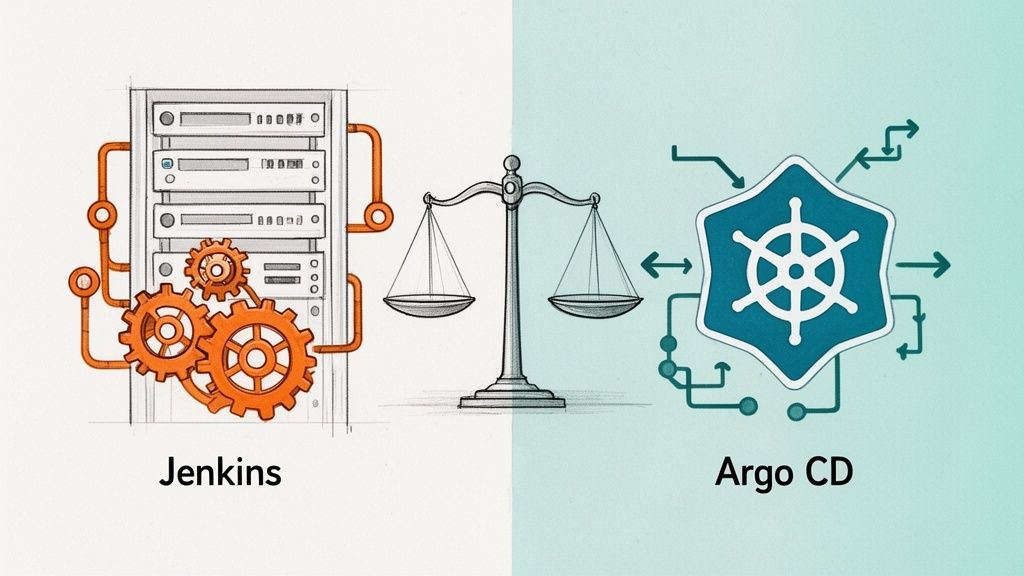
The "Argo CD vs. Jenkins" debate is not about which tool is better, but which operational model aligns with your architecture and engineering philosophy. It's a choice between imperative, push-based execution and declarative, pull-based reconciliation.
At its core, Jenkins is an imperative, general-purpose CI/CD automation server. It functions as a powerful workflow engine. You provide a script (a Jenkinsfile), and it executes the defined steps sequentially to build, test, and deploy. You are explicitly telling your system how to perform each action.
Argo CD, in contrast, is a declarative, GitOps-focused continuous delivery tool built specifically as a Kubernetes controller. It operates on a reconciliation loop. You declare the desired state of your application manifests in a Git repository, and Argo CD's sole function is to continuously ensure the live state of your Kubernetes cluster matches that declared state.
Core Differences Jenkins vs Argo CD
Jenkins has been the cornerstone of enterprise automation for over a decade, offering unparalleled flexibility to orchestrate CI/CD pipelines across any target environment, from bare-metal servers and VMs to containers. Its strength lies in its procedural control and extensibility, which is why it maintains a significant 40% market share in the enterprise CI/CD space. It is a true jack-of-all-trades.
Argo CD is a specialist. It does not build your code, run your unit tests, or manage infrastructure outside of Kubernetes. It excels at one task: deploying and managing the lifecycle of applications on Kubernetes using a pull-based GitOps model. This approach provides a cryptographically verifiable audit trail via Git history, enhances security by limiting cluster credentials, and enables reliable, automated rollbacks and progressive delivery strategies.
For a broader perspective on how these tools fit into the current landscape, a review of the best CI/CD tools can provide valuable context.

Quick Comparison Argo CD vs Jenkins
This table highlights the fundamental architectural and philosophical differences that define each tool's ideal use case.
| Criterion | Jenkins | Argo CD |
|---|---|---|
| Primary Role | General-purpose CI/CD (Build, Test, Deploy) | Continuous Delivery (CD) for Kubernetes only |
| Operational Model | Imperative (Push-based): Executes scripted steps defined in a Jenkinsfile. |
Declarative (Pull-based): Reconciles the live state with the desired state defined in Git. |
| Scope | End-to-end CI and CD for any target. | CD and application lifecycle management on Kubernetes. |
| Architecture | Server-based (Master-Agent) | Kubernetes-native (Controller/Operator pattern) |
| Ecosystem | Massive plugin library (>2,000) for universal integration. | Focused on Kubernetes tooling (Helm, Kustomize, Jsonnet). |
So, what's the bottom line?
If you require a flexible automation server to manage heterogeneous CI/CD tasks across diverse environments (VMs, bare-metal, containers), Jenkins is a proven, powerful choice. If you have standardized on Kubernetes and seek a modern, declarative system that enforces Git as the single source of truth for deployments, Argo CD is purpose-built for that paradigm.
Understanding the Core Architectures: Push vs. Pull

To truly grasp the difference between Argo CD and Jenkins, you must analyze their core architectures. These aren't just implementation details; they dictate your operational model, security posture, and failure modes.
Jenkins: The Classic, “Do-Anything” Engine
Jenkins operates on a robust master-agent architecture. A central Jenkins master orchestrates workflows by dispatching tasks to a fleet of agent nodes that perform the actual execution. This model provides immense flexibility, allowing agents to run on different operating systems or architectures.
The power and complexity of Jenkins stem from its imperative, script-driven nature. A Jenkinsfile—a Groovy-based Domain-Specific Language (DSL)—defines the pipeline as a series of sequential or parallel stages. For example: git checkout, mvn clean install, docker build, and kubectl apply.
Its legendary extensibility comes from a massive library of over 2,000 plugins, enabling integration with virtually any tool or platform.
With Jenkins, you direct the workflow. The Jenkinsfile provides granular control to build complex pipelines for any target, from legacy bare-metal servers to modern cloud instances.
A classic push-based Jenkins CD pipeline for a VM deployment might look like this in a Jenkinsfile:
stage('Deploy') {
    steps {
        script {
            sshagent(credentials: ['my-ssh-key']) {
                sh 'scp target/app.jar user@prod-vm:/opt/app/'
                sh 'ssh user@prod-vm "sudo systemctl restart my-app"'
            }
        }
    }
}
This is a “push-based” model. The Jenkins server actively pushes changes out to your infrastructure. While highly adaptable, it means the Jenkins server and its pipelines become a central point of control, holding credentials and the logic for every target system.
Argo CD: The Kubernetes-Native Synchronizer
Argo CD is the architectural antithesis of Jenkins. It's a Kubernetes-native controller designed to run inside the cluster and interact directly with the Kubernetes API server. It was built exclusively for managing applications on Kubernetes.
Its philosophy is declarative and pull-based, the core tenets of GitOps.
You do not provide a script telling Argo CD how to deploy. Instead, you describe the desired state of your application in a Git repository using standard Kubernetes manifests, Helm charts, or Kustomize overlays. This Git repository is the immutable single source of truth.
Argo CD’s reconciliation loop continuously monitors that Git repository and the live state of the application in the cluster. When it detects a drift—a mismatch between the declared state in Git and the live state—it automatically “pulls” the configuration from Git and applies it to the cluster, correcting the drift. Its only objective is to ensure the cluster's state converges with what is declared in Git.
The core philosophical divide is this: Jenkins gives you an imperative toolkit to do anything. Argo CD gives you a declarative system to describe everything and have it automatically enforced.
This architectural split creates a clean separation of concerns. A CI tool like Jenkins or GitLab CI is still responsible for building container images and running tests. After a successful build, the CI tool's final action is to commit a change to the GitOps repository—typically updating an image tag in a Kubernetes Deployment manifest. Argo CD detects this change and handles the entire deployment process, ensuring the cluster always reflects the true desired state. This model is foundational to a modern Kubernetes CI/CD pipeline.
A Granular Feature Comparison: CI vs. CD
Beyond the high-level architecture, the daily operational differences between Argo CD and Jenkins emerge in pipeline definition, scalability, security, and ecosystem integration. These are the factors that directly impact your team's velocity and system reliability.
Pipeline Definition: Imperative vs. Declarative
The most significant divergence is how you instruct each tool. Jenkins uses an imperative model via the Jenkinsfile. This Groovy script specifies the exact sequence of commands, granting immense power to run any shell command, implement complex conditional logic (when blocks), and interact with non-Kubernetes systems.
// Example Jenkinsfile Stage
stage('Build and Push') {
    steps {
        script {
            def appImage = docker.build("my-app:${env.BUILD_ID}")
            docker.withRegistry('https://myregistry.com', 'registry-credentials') {
                appImage.push()
            }
        }
    }
}
Argo CD is purely declarative. You define the desired state in Git using standard Kubernetes YAML, Helm charts, or Kustomize. There are no procedural scripts.
# Example Argo CD Application manifest
apiVersion: argoproj.io/v1alpha1
kind: Application
metadata:
  name: my-app
  namespace: argocd
spec:
  project: default
  source:
    repoURL: 'https://github.com/my-org/my-app-config.git'
    path: overlays/production
    targetRevision: HEAD
  destination:
    server: 'https://kubernetes.default.svc'
    namespace: my-app-prod
With Jenkins, you define the process. With Argo CD, you define the outcome. Jenkins executes a workflow; Argo CD ensures a state. This shift is the heart of the GitOps philosophy.
This declarative approach guarantees idempotency and convergence. You cannot execute a one-off, state-altering command; the only way to modify the system is by updating its declarative definition in Git.
Scalability: Master-Agent vs. Kubernetes-Native
Jenkins scales using a master-agent architecture. The master node orchestrates jobs, which are executed by a fleet of agent nodes (VMs, containers). While flexible, this model introduces significant management overhead.
- Master Bottleneck: A single Jenkins master can become a performance chokepoint and a single point of failure (SPOF) in large-scale environments with thousands of jobs.
- Agent Management: You are responsible for provisioning, configuring, patching, and securing all agent nodes and their toolchains (e.g., specific versions of Java, Node.js, Docker).
- CI Scaling: This model is effective for scaling heterogeneous build jobs but is not optimized for the API-driven, dynamic nature of Kubernetes deployments.
Argo CD is Kubernetes-native and leverages Kubernetes' own scalability mechanisms. Its components (API server, repository server, application controller) run as pods within the cluster. To scale, you simply increase the replicas count in their respective Deployments. It's a horizontally scalable design.
This allows Argo CD’s capacity to manage applications to scale linearly with your cluster. It delegates reconciliation tasks to its controllers, which are highly optimized for interacting with the Kubernetes API. This makes it exceptionally efficient at managing thousands of applications across multiple clusters. For a deeper look at different toolsets, you can explore our comprehensive CI/CD tools comparison to see how this model stacks up.
Security Models: Credentials vs. Git-Based RBAC
Jenkins security has traditionally centered on its credential management system. Secrets (SSH keys, API tokens, passwords) are stored within the Jenkins master and injected into pipelines at runtime. This model is functional but presents a significant security risk.
The Jenkins master becomes a high-value target; a compromise could expose every secret it manages. The vast plugin ecosystem, while a strength, also expands the attack surface. A vulnerability in a single plugin could compromise the entire system.
Argo CD’s security model is built on Git and Kubernetes RBAC.
- Git as the Audit Trail: Every change to your application's state must be a Git commit, creating an immutable, cryptographically verifiable audit log. You have a record of who changed what, when, and the associated commit hash.
- Limited Cluster Access: The only component that requires privileged cluster credentials is the Argo CD controller itself. Developers and CI pipelines do not need direct
kubectlaccess to deploy applications. - Kubernetes RBAC: Argo CD integrates natively with Kubernetes Role-Based Access Control (RBAC). You can define fine-grained permissions controlling which users or teams can sync which applications to specific namespaces or clusters.
This GitOps approach dramatically reduces the attack surface by moving the source of truth for deployments outside the cluster and placing it under the auditable governance of a version control system.
Ecosystem and Integrations
In terms of integration breadth, Jenkins is the undisputed champion. With a history dating back to 2004, its market presence is well-established. Jenkins has a 46.35% share of the CI/CD tool market, while Argo CD is a specialized player within the Kubernetes ecosystem. You can discover more insights about these DevOps trends and statistics.
With over 2,000 plugins, Jenkins can interface with nearly any system, making it ideal for managing complex, hybrid-cloud enterprise pipelines.
Argo CD’s ecosystem is smaller and intentionally focused. Its integrations are centered on the Kubernetes ecosystem:
- Manifest Tools: It offers first-class support for Helm, Kustomize, Jsonnet, and plain Kubernetes YAML.
- Monitoring: It exposes detailed Prometheus metrics for monitoring application health, sync status, and controller performance out of the box.
- CI Tools: It integrates cleanly with any CI tool—including Jenkins—that can execute a
git commitandgit pushto a Git repository.
This focus enables Argo CD to excel at its core function, while Jenkins provides a broad, general-purpose automation platform.
Choosing Your Architectural Pattern and Use Case
Let's translate theory into practice. The critical question isn't "which tool is better?" but "which architectural pattern best serves my team, my infrastructure, and my operational goals?"
The optimal choice depends on your current state and strategic direction. Below are three common architectural patterns, serving as blueprints for your organization. We will examine a traditional Jenkins-only setup, a pure GitOps model with Argo CD, and a hybrid approach that synergizes the strengths of both.
Pattern 1: The Traditional Jenkins Powerhouse
This is the default pattern for organizations managing significant non-Kubernetes infrastructure. If your environment is a heterogeneous mix of legacy applications, virtual machines, and some containerized services, this architecture provides a single, unified automation tool.
Typical Organization: A well-established enterprise with mission-critical applications on bare-metal or VMs. They are adopting Kubernetes but it is not the sole deployment target. Their teams are highly skilled in scripting (e.g., Bash, Groovy) and traditional system administration.
How it Works:
- A central Jenkins master server acts as the orchestration hub.
- Pipelines, defined as a
Jenkinsfile, codify every step of the CI/CD process: compiling code, executing test suites, and deploying artifacts. - Jenkins agents, installed on target servers or running as ephemeral containers, execute the pipeline stages, using mechanisms like SSH for file transfers and remote execution.
This is the classic "workhorse" model. Jenkins handles the entire CI/CD lifecycle with unmatched flexibility. Its ability to automate any task on any platform is indispensable when Kubernetes is just one component in a larger, more complex IT landscape.
This architecture provides complete, imperative control, ideal for intricate workflows requiring step-by-step procedural logic.
Pattern 2: The Modern GitOps Engine
This pattern is designed for teams that are fully committed to Kubernetes as their primary application platform. The objective is to achieve consistency, auditability, and automation through a declarative, pull-based GitOps workflow orchestrated by Argo CD.
Typical Organization: A cloud-native company or a technology-forward enterprise that has standardized on Kubernetes. Their engineers are proficient with declarative configuration (IaC), and they value a strict separation of concerns between CI (building artifacts) and CD (deploying them).
How it Works:
- Git is the single source of truth. One or more Git repositories store all Kubernetes manifests—YAML files, Helm charts, or Kustomize overlays—that declaratively define the entire application state.
- The Argo CD controller runs within the Kubernetes cluster, continuously monitoring the specified Git repositories for new commits.
- When a change is committed and pushed to the target branch in Git (e.g., a CI pipeline updates an image tag), Argo CD automatically "pulls" the new manifest and applies it to the cluster. The live state is perpetually forced to converge with the desired state in Git. Developers do not use
kubectl applyto make changes.
This model enforces a strict, auditable, and self-healing deployment workflow. Every modification to the production environment is a traceable Git commit.
Pattern 3: The Hybrid Power Couple
This is the most common and pragmatic pattern I implement for organizations in transition. It leverages the best of both worlds by assigning each tool to its area of strength: Jenkins for CI, Argo CD for CD.
This pattern is ideal for organizations migrating to Kubernetes that want to retain their powerful, mature CI system while adopting the safety and developer experience of GitOps for Kubernetes deployments.
Typical Organization: A growing enterprise moving applications to Kubernetes. They rely on Jenkins' robust capabilities for complex build and test orchestrations but desire the reliability and declarative nature of GitOps for their Kubernetes cluster deployments.
How it Works:
- CI in Jenkins: A developer pushes code, triggering a Jenkins pipeline. The pipeline compiles the code, builds a container image, runs unit and integration tests, scans the image for vulnerabilities, and pushes the final, tagged image to a container registry.
- The Handoff: The crucial final step in the Jenkins pipeline is a single, atomic action: it clones a separate GitOps configuration repository, updates a manifest file (e.g., a
values.yamlfor a Helm chart) with the new image tag, and pushes the change. - CD by Argo CD: Argo CD, which is monitoring the GitOps repository, immediately detects the new commit. It recognizes the change in the desired state (the new image tag) and initiates a sync operation, safely rolling out the new version of the application to the Kubernetes cluster.
This hybrid architecture creates a clear separation of concerns: Jenkins owns the complex CI process, while Argo CD manages Kubernetes deployments with the full safety, auditability, and declarative power of GitOps. It provides a practical, evolutionary path to modernizing your delivery pipeline without a disruptive "big bang" migration.
Tool Selection Matrix Based on Use Case
This matrix helps map your specific requirements to the most suitable architectural pattern. It's a practical guide to facilitate your decision-making process.
| Requirement | Choose Jenkins | Choose Argo CD | Choose Both (Hybrid) |
|---|---|---|---|
| Primary Infrastructure | Mixed: VMs, bare-metal, and some Kubernetes. | Kubernetes-native, all-in on containers. | Migrating from VMs/bare-metal to Kubernetes. |
| Team Expertise | Strong scripting skills (Groovy, Bash, Python). | Strong with YAML, Kubernetes manifests, and Git. | A mix of both skillsets; want to upskill in GitOps. |
| Deployment Logic | Need complex, imperative, step-by-step logic. | Need declarative state management and reconciliation. | Need complex build logic but simple, safe deployments. |
| Primary Goal | Centralize all automation (CI/CD) in one tool. | Achieve a pure, auditable GitOps workflow. | Modernize deployments without replacing existing CI. |
| Developer Experience | Developers trigger jobs and view logs in Jenkins UI. | Developers push a commit and watch Argo CD sync. | Developers trigger a CI job that leads to a GitOps sync. |
| Automation Scope | Beyond deployments: server provisioning, DB migrations. | Strictly Kubernetes application deployments and config. | Jenkins handles pre-deployment tasks; Argo CD handles the K8s part. |
| Security Model | Jenkins has broad credentials to all target systems. | Argo CD's permissions are scoped only to Kubernetes. | Jenkins needs registry access; Argo CD needs K8s access. Clean separation. |
While this matrix provides strong directional guidance, remember that the most successful implementations are tailored to an organization's unique context. The "Hybrid" pattern often provides the most pragmatic and valuable path forward for established teams.
Making the Right Call for Your Team
Choosing between Argo CD and Jenkins is a strategic decision with long-term implications for your team's workflow, operational overhead, and delivery velocity. To make an informed choice, you must evaluate these tools against your organization's specific technical and cultural landscape.
The right answer depends on your infrastructure, your team's skillset, and your strategic objectives.
Infrastructure and Team Skills
The single most important factor in the Argo CD vs. Jenkins decision is your deployment target environment.
If your organization has standardized on Kubernetes as its primary application platform, Argo CD is the architecturally aligned choice. It is designed as a native Kubernetes controller, providing an efficiency, reliability, and security model that a general-purpose tool cannot easily match.
Conversely, if your infrastructure is a heterogeneous mix of VMs, bare-metal servers, and Kubernetes clusters, Jenkins' flexibility is its defining advantage. Its vast plugin ecosystem and scriptable nature make it a powerful orchestrator for complex, multi-platform environments.
The question really boils down to this: Are you standardizing on Kubernetes, or are you managing a diverse zoo of infrastructure? Your answer will point you straight to either Argo CD's specialization or Jenkins' jack-of-all-trades power.
Your team's existing expertise is equally critical. A team proficient in Groovy, shell scripting, and systems administration will find Jenkins to be a powerful and familiar tool. However, if your team's primary skillset lies in YAML, Kubernetes manifests, and Git-centric workflows, they will adopt Argo CD and the GitOps model with minimal friction, as it aligns directly with their existing mental models.
Total Cost of Ownership and Your Goals
While both tools are open-source, their Total Cost of Ownership (TCO) manifests in different ways.
- Jenkins TCO: The cost is predominantly in maintenance and operational overhead. This includes managing the master node's availability and performance, patching plugins, managing tool dependencies on agents (Java versions, etc.), and securing a system that often holds credentials to critical infrastructure. This operational burden scales with the number and complexity of your pipelines.
- Argo CD TCO: The cost is absorbed into your Kubernetes operational maturity. As a Kubernetes-native application, its TCO is part of the overall cost of running and maintaining your clusters. Maintenance is typically simpler (e.g., updating a controller via Helm), but its effective use requires a solid organizational understanding of GitOps principles and Kubernetes itself.
Your strategic goals are also a key factor. Jenkins offers ultimate flexibility, which can lead to a proliferation of disparate, brittle pipelines that create operational silos. Argo CD, by contrast, enforces standardization through its declarative GitOps model. This delivers consistency and a complete audit trail at the cost of some procedural flexibility.
This chart provides a clear decision-making framework based on your primary deployment target.

As illustrated, a strong commitment to Kubernetes makes Argo CD a compelling choice. A mixed-environment reality makes Jenkins a more logical fit, with the hybrid model serving as a powerful bridge between the two worlds.
A Checklist for Your Team
Convene your engineering and operations teams to discuss these questions. The answers will illuminate the most effective path forward for your organization.
- What's our biggest bottleneck right now? Is it slow, flaky builds and tests (a CI problem), or risky, manual, and inconsistent deployments (a CD problem)?
- Where are our apps running? Are we 100% Kubernetes, or do we manage a mix of VMs, bare-metal servers, and other legacy systems? What is our realistic 3-year infrastructure roadmap?
- Is GitOps a good cultural fit? Is our team prepared and willing to adopt the discipline of treating Git as the single source of truth for application state, including peer review for all deployment changes?
- What do we value more: flexibility or standardization? Is it more important for developers to have the freedom to "just run a script" in a pipeline, or for all deployments to be consistent, auditable, and self-healing?
- What does our team know today? Are we staffed with scripting experts (Groovy, Bash) or declarative configuration specialists (YAML, Helm, Kustomize)?
A complete DevOps toolchain extends beyond CI/CD. Integrating complementary tools, such as the best API testing tools, is vital for embedding quality gates directly into your automated pipelines.
Ultimately, the Argo CD vs. Jenkins decision is about aligning your tooling with your architecture, your people, and your strategic goals.
How OpsMoon Helps You Get CI/CD Right
Choosing between Argo CD and Jenkins isn't just a technical debate. It's a strategic decision that shapes how you deliver software. Get it wrong, and you're stuck with friction and slowdowns. Get it right, and you build a real advantage. This is where we come in. We skip the theory and create a practical, actionable plan that delivers results.
It all starts with a simple, no-strings-attached work planning session. One of our senior architects will sit down with you to understand your current setup—your teams, your infrastructure, your goals. From there, we’ll map out the best path forward, whether that means supercharging your existing Jenkins setup, making a clean switch to Argo CD, or building a hybrid model that gives you the best of both.
Finding Engineers Who Can Actually Execute
Once you have a plan, you need people who can build it. This is often the biggest bottleneck. Finding engineers who truly understand Jenkins, are fluent in Kubernetes and GitOps for Argo CD, or know how to bridge the two is incredibly difficult.
Our Experts Matcher technology was built to solve this exact problem. We connect you with pre-vetted engineers from the top 0.7% of the global talent pool.
These aren't just bodies to fill seats. They're the experts you need to:
- Build a modern CI/CD pipeline from scratch.
- Migrate all those legacy Jenkins jobs into a clean, declarative GitOps workflow.
- Architect and run a hybrid system that leverages the strengths of both tools without the chaos.
We de-risk your CI/CD modernization by pairing a solid strategy with the elite engineers who can actually implement it. We close the gap between the whiteboard diagram and a pipeline that just works.
Your Partner in Modernization
Whether you need to add some horsepower to your existing team for a few hours a week or you want us to handle an entire project from start to finish, we fit your needs. Our job is to make your transition smooth and successful, period. We bring the expert guidance and the hands-on talent to build resilient, efficient delivery pipelines.
When you work with OpsMoon, you get an ally who is just as invested in your success as you are. To see how we build and refine delivery pipelines for teams like yours, check out our CI/CD services and let’s talk about what you want to build next.
Frequently Asked Technical Questions
Engineers evaluating Argo CD vs Jenkins frequently encounter the same technical considerations. Here are the most common questions, with actionable, technically-grounded answers.
Can Argo CD Completely Replace Jenkins?
No, because they are fundamentally different tools designed for different parts of the software delivery lifecycle. A better question is "How do they work together?"
Jenkins is a general-purpose CI/CD engine that excels at Continuous Integration (CI): compiling code, running diverse test suites, performing static analysis, and building artifacts like container images. Argo CD, in contrast, is a specialized Continuous Delivery (CD) tool for Kubernetes.
The most effective and widely adopted pattern is the hybrid model: Use Jenkins for its powerful CI capabilities. The pipeline builds the container image and runs all tests. Its final, successful step is to commit a single change to a separate GitOps repository—updating an image tag in a Helm
values.yamlor a Kustomize overlay. Argo CD, watching this repository, then takes over to handle the deployment to Kubernetes, enforcing GitOps principles.
This creates a clean, secure separation of concerns. Jenkins owns the build-and-test process; Argo CD owns the declared state of the application in the cluster.
How Do You Manage Secrets in Argo CD vs Jenkins?
Secrets management highlights the core philosophical difference between the two tools.
- Jenkins: The traditional method uses the internal Credentials Store. Secrets (API keys, SSH keys, passwords) are stored within the Jenkins master and injected into pipelines as environment variables at runtime. This creates a high-value target and couples your secrets management to your CI server.
- Argo CD: It is designed to integrate with external, Kubernetes-native secret management solutions. The best practice is to use a tool like HashiCorp Vault with the Vault Secrets Operator, or Sealed Secrets. With this approach, you commit encrypted secrets to your Git repository. An in-cluster controller is the only component with the decryption key, allowing you to manage secrets declaratively via Git without exposing them in plaintext.
What Is the Learning Curve for Each Tool?
The learning curves are steep in different areas, requiring distinct prerequisite knowledge.
- Jenkins: A basic freestyle job or pipeline is simple to start. However, achieving mastery requires deep knowledge of its extensive plugin ecosystem and proficiency in Groovy for writing complex, maintainable
Jenkinsfiles. The primary challenge is managing the procedural complexity and state of a large, imperative system over time. - Argo CD: The tool itself is relatively simple, with a well-defined, narrow scope. The learning curve is not in Argo CD, but in the ecosystem it requires. To use it effectively, your team must be proficient with Kubernetes, Git, and declarative configuration tools like Kustomize or Helm.
Migrating from an imperative Jenkins model to a declarative Argo CD workflow is less about learning a new tool and more about embracing a fundamental shift in your team's operational culture and architectural patterns.
At OpsMoon, we help teams work through these exact technical trade-offs every day. Our experts can build a practical roadmap and bring in the elite engineering talent you need to modernize your pipelines, making sure you get the absolute most out of your CI/CD stack. Find out how we can help.