
A Technical Guide to Cloud Transformation Consulting
 By opsmoon
Explore our technical guide on cloud transformation consulting. Learn to build a strategic roadmap, assess maturity, and choose the right technical partner.
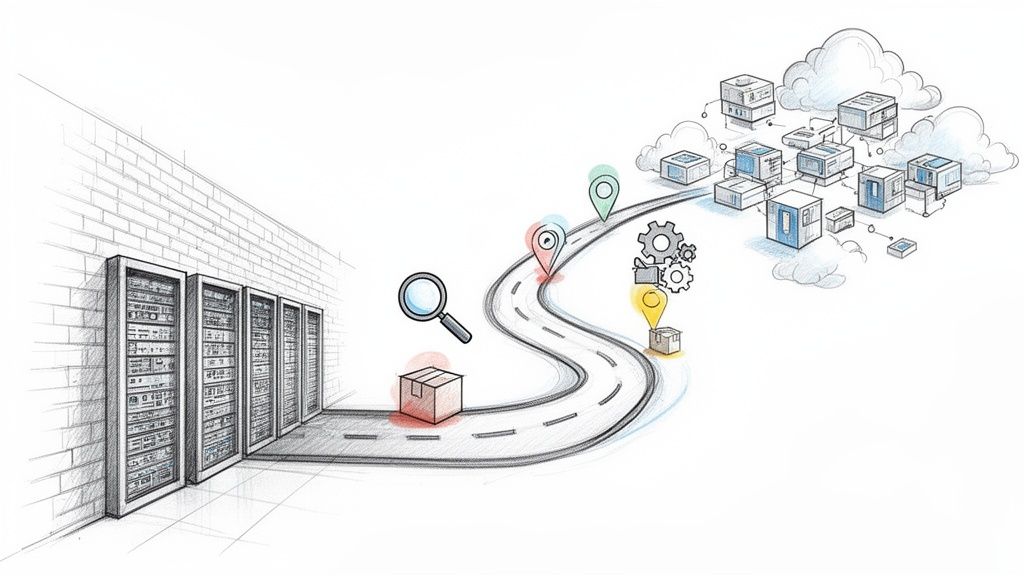
Cloud transformation consulting is a strategic partnership designed to re-architect a company's technology, operations, and culture to fully leverage cloud-native capabilities. It extends far beyond a simple server migration; the primary objective is to redesign applications and infrastructure workflows for maximum efficiency, scalability, and resilience using modern engineering practices.
This isn't about moving to the cloud. It's about re-platforming to thrive in it.
Defining True Cloud Transformation
Think of it this way: a simple cloud migration is like moving your factory's machinery to a new, bigger building. Cloud transformation is redesigning the entire production line inside that new building with robotics, real-time analytics, and automated supply chains. It’s a foundational shift in how your business operates, from the way you provision infrastructure to how you build, deploy, and observe applications.
This entire process rests on three core technical pillars.
The Core Technical Pillars
Any comprehensive cloud transformation journey leans on specialized expertise in three distinct areas, with each one building on the last:
- Strategic Advisory: This is where the architectural blueprint is defined. Consultants perform a deep analysis of your existing application portfolio, map out inter-service dependencies and data flows, and define the target state architecture. This stage involves concrete decisions on cloud service selection (e.g., Kubernetes vs. Serverless, managed vs. self-hosted databases) and the creation of a phased, technical roadmap.
- Technical Execution: With the blueprint approved, engineers get hands-on. This involves constructing secure and compliant cloud landing zones using Infrastructure as Code (IaC), implementing robust CI/CD pipelines, and executing the migration or refactoring of applications. This is the heavy lifting of building your new cloud foundation, from networking VPCs to configuring IAM policies.
- Cultural Change Management: Advanced technology is ineffective without skilled operators. This pillar focuses on upskilling your teams with the necessary competencies to manage a cloud-native ecosystem. It means hands-on training for new tooling, embedding DevOps and SRE principles into daily workflows, and fostering a culture of continuous improvement and operational ownership.
Beyond a Simple 'Lift-and-Shift'
It is technically imperative to understand the difference between a genuine transformation and a basic "lift-and-shift" migration. While moving existing virtual machines as-is into the cloud might offer a short-term timeline, it rarely delivers the promised benefits of cloud computing. You often end up with the same monolithic applications and manual operational processes, just running on someone else's hardware—frequently at a higher, unoptimized cost.
True cloud transformation is about fundamentally changing how applications are built, deployed, and operated. This means decomposing monolithic applications into discrete microservices, containerizing them with Docker, and orchestrating them with platforms like Kubernetes.
This modern architectural approach is what unlocks the real technical advantages of the cloud. For instance, by refactoring an e-commerce platform into microservices, you can independently scale the checkout service during a high-traffic event without over-provisioning resources for the entire application. Adopting serverless architectures (e.g., AWS Lambda, Google Cloud Functions) for event-driven workloads is another game-changer, allowing you to run code without provisioning or managing servers and paying only for the precise compute time consumed. You can dive deeper into these nuances in our guide to cloud migration consulting.
The business drivers for this deep technical change are rooted in performance and agility. Companies execute cloud transformations to gain the elastic scalability needed for unpredictable traffic, reduce TCO with pay-as-you-go pricing models, and accelerate development velocity by leveraging powerful cloud-native services like managed databases (e.g., RDS, Cloud SQL) and AI/ML platforms. It's a strategic move that turns your technology from a cost center into a tangible engine for business growth.
Assessing Your Cloud Maturity with a Practical Framework
Before you can construct a viable cloud transformation roadmap, you must establish a precise baseline of your current state. Attempting to plan without this data is like trying to debug a distributed system without logs or traces—you’ll just end up chasing ghosts. A cloud maturity framework is a diagnostic tool that provides CTOs and technical leaders with an objective, data-driven assessment of their organization's technical and operational readiness.
This is not a high-level checklist. It's a granular analysis of your infrastructure provisioning methods, application architecture patterns, and operational procedures. By accurately identifying your current stage, you can pinpoint specific capability gaps, prioritize technical investments, and build a quantitative business case for engaging cloud transformation consulting experts to accelerate your progress.
The Four Stages of Cloud Maturity
Organizations do not instantly become "cloud-native." It's an evolutionary process through four distinct stages. Each level is characterized by specific technical indicators that reveal how deeply cloud-native principles have been integrated into your engineering and operations.
- Stage 1 Foundational: This is the traditional on-premise model. Your infrastructure consists of physical or virtual servers configured via manual processes or bespoke scripts. Deployments are high-risk, infrequent, monolithic events, and your applications are likely large, tightly coupled systems.
- Stage 2 Developing: You've begun experimenting with cloud services. Perhaps you’re using basic IaaS (e.g., EC2, Compute Engine) for some workloads or have a rudimentary CI pipeline for automated builds. However, infrastructure is still largely managed manually, and deployment processes lack robust automation and validation.
- Stage 3 Mature: Cloud-native practices are becoming standard. You are using Infrastructure as Code (IaC) tools like Terraform to declaratively manage and version-control your environments. Most applications are containerized and run on IaaS or PaaS, and your CI/CD pipelines automate testing, security scanning, and deployments.
- Stage 4 Optimized: You operate at a high level of automation and efficiency. Operations are driven by GitOps workflows, where the Git repository is the single source of truth for both application and infrastructure configuration. FinOps is an integral part of your engineering culture, ensuring cost-efficiency. You may be leveraging multi-cloud or serverless architectures to optimize for cost, performance, and resilience.
To make this concrete, here’s a framework that details what each stage looks like across key technical domains.
Cloud Maturity Assessment Framework
This table helps you pinpoint your current stage of cloud adoption by looking at technical and operational signposts. It’s a good way to get an objective view of where you stand today.
| Maturity Stage | Infrastructure & Automation | Application Architecture | Operational Model |
|---|---|---|---|
| Foundational | Manual server provisioning; physical or basic virtualization; no automation. | Monolithic applications; tightly coupled dependencies; infrequent, large releases. | Reactive incident response; siloed teams (Dev vs. Ops); manual change management. |
| Developing | Some IaaS adoption; basic CI pipelines; scripts for ad-hoc automation. | Some services decoupled; limited container use (e.g., Docker); inconsistent release cycles. | Basic monitoring in place; teams begin to collaborate; some manual approval gates. |
| Mature | Infrastructure as Code (IaC) is standard; automated CI/CD pipelines; widespread PaaS/IaaS use. | Microservices architecture; container orchestration (e.g., Kubernetes); frequent, automated deployments. | Proactive monitoring with alerting; cross-functional DevOps teams; automated governance. |
| Optimized | GitOps-driven automation; FinOps practices integrated; serverless and multi-cloud architectures. | Event-driven architectures; service mesh for observability; continuous deployment on demand. | AIOps for predictive insights; SRE culture of ownership; fully automated security and compliance. |
Having a framework like this gives you a common technical language to discuss where you are and, more importantly, where you need to go. It transforms a vague ambition of "moving to the cloud" into a series of concrete, measurable engineering initiatives.
This diagram helps visualize how a successful transformation flows from the top down, starting with a clear strategy.
As you can see, a great project is built on three pillars: a high-level strategy, solid technical execution on the ground, and a people-first approach to managing change.
From Self-Assessment to Strategic Action
Once you've identified your current stage, the next step is to translate that assessment into an actionable plan. This is precisely where a cloud transformation consulting partner adds immense value. They leverage their experience to convert your internal diagnosis into a formal, data-backed strategy that is technically feasible and aligned with business objectives.
The demand for this expertise is growing rapidly. Cloud professional services, the engine behind cloud consulting, reached USD 26.3 billion in 2024 and are projected to hit USD 130.4 billion by 2034. This growth is driven by companies requiring expert guidance to navigate the complexities of building secure, scalable, and cost-effective cloud platforms. You can learn more about the market forces driving cloud consulting to see the full picture.
A formal assessment from a consulting partner will deliver:
- Technical Gap Analysis: A detailed report identifying specific deficiencies in your tooling, architectural patterns, and operational processes.
- Risk Mitigation Plan: A clear strategy for remediating security vulnerabilities, addressing compliance gaps (e.g., SOC 2, HIPAA), and mitigating operational risks identified during the assessment.
- Prioritized Initiatives: A concrete list of engineering projects, ordered by business impact and technical feasibility, which forms the core of your transformation roadmap.
An honest maturity assessment prevents you from wasting capital on advanced tools your team isn't ready to operate, or worse, underestimating the foundational infrastructure work required for success. It ensures your transformation is built on a solid engineering foundation.
And remember, this isn’t just about technology—it’s about your people and processes, too. A robust maturity model also evaluates your team's skillsets, your security posture, and your FinOps capabilities. If you want to go deeper on this, check out our guide on how to run a DevOps maturity assessment.
At the end of the day, understanding where you are is the only way to get where you want to go.
Building Your Cloud Transformation Roadmap
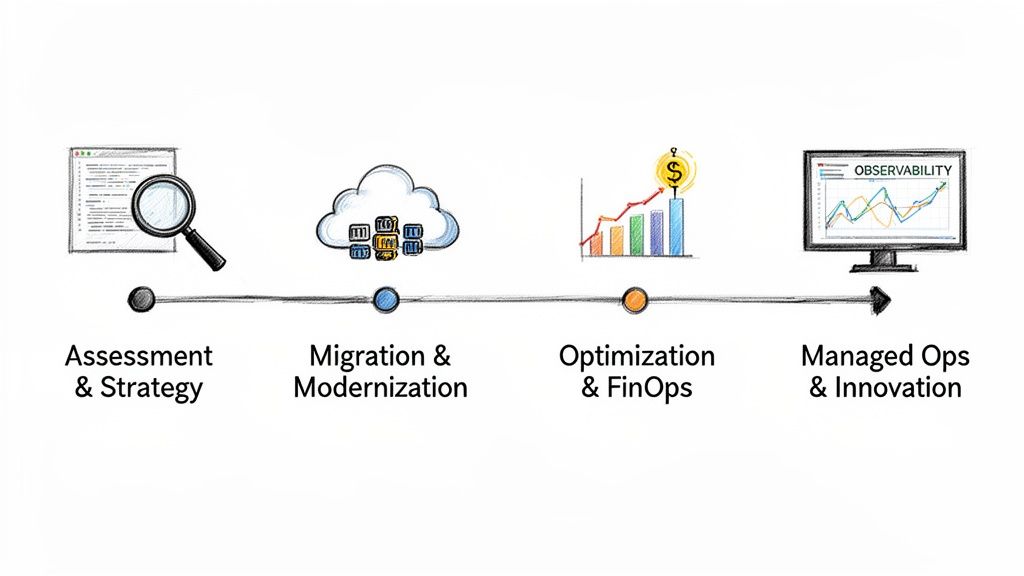
Executing a cloud transformation is not a single event; it's a meticulously planned program of work, broken down into distinct, interdependent phases. For any technical leader, this plan is your cloud transformation roadmap—a living document that translates high-level business goals into concrete engineering milestones, epics, and sprints.
Proceeding without a roadmap is a recipe for failure, leading to uncontrolled costs, significant technical debt, and a failure to realize the cloud's promised benefits. A well-structured plan ensures each phase builds logically on the previous one, guiding your organization from initial discovery to continuous innovation.
Phase 1: Assessment and Strategy
This initial phase is dedicated to discovery and planning. Before any infrastructure is provisioned, a deep technical audit of your current environment is mandatory. This involves mapping application dependencies using observability tools, analyzing performance metrics to establish baselines, and conducting thorough security vulnerability scans.
A critical output of this phase is the application portfolio analysis. Using a framework like the "6 Rs of Migration" (Rehost, Replatform, Refactor, Repurchase, Retire, Retain), each application is categorized based on its business criticality and technical architecture. This systematic approach prevents a "one-size-fits-all" migration strategy, ensuring that engineering resources are focused on modernizing the systems that deliver the most business value.
This phase also includes a technical evaluation of cloud providers. This analysis must go beyond pricing comparisons:
- Service Mesh Capabilities: Does the provider offer a managed service mesh (e.g., AWS App Mesh, Google Anthos Service Mesh) or robust support for open-source tools like Istio or Linkerd? This is crucial for managing traffic, security, and observability for microservices.
- Data Egress Costs: What are the precise costs for data transfer between availability zones, regions, and out to the internet? These costs must be modeled accurately to avoid significant, unexpected expenses.
- Compliance and Sovereignty: Can the provider meet specific regulatory requirements for data residency and provide necessary compliance attestations (e.g., FedRAMP, HIPAA BAA)?
Phase 2: Migration and Modernization
With a detailed strategy, execution begins. The first step is constructing a secure landing zone. This is the foundational scaffolding of your cloud environment, built entirely with Infrastructure as Code (IaC) using tools like Terraform. This ensures that your networking (VPCs, subnets, routing), identity management (IAM roles and policies), and security controls are automated, version-controlled, and auditable from day one.
Next, we execute the migration patterns defined in Phase 1. Each path has distinct technical implications:
- Rehosting ("Lift and Shift"): The fastest migration path, involving the direct migration of existing VMs. While it minimizes application changes, it often fails to leverage cloud-native features, potentially leading to higher operational costs and lower resilience.
- Replatforming ("Lift and Reshape"): A pragmatic approach where applications are modified to use managed cloud services. A common example is migrating a self-hosted PostgreSQL database to Amazon RDS or Azure Database for PostgreSQL. This reduces operational burden and improves performance.
- Refactoring: The most intensive approach, involving complete re-architecture to a cloud-native model (e.g., decomposing a monolith into microservices running on Kubernetes). This is complex but unlocks the full potential of the cloud for scalability, resilience, and agility.
A common technical error is to default to "lift and shift" for all workloads. An effective consulting partner will advocate for a pragmatic, hybrid approach—refactoring high-value, business-critical applications while rehosting or replatforming less critical systems to manage complexity and accelerate time-to-value.
Phase 3: Optimization and FinOps
Deploying to the cloud is just the beginning. Operating efficiently without incurring runaway costs is a continuous discipline. This phase focuses on relentless optimization and embedding a culture of financial accountability, known as FinOps, directly into engineering workflows.
The technical work here includes:
- Instance Right-Sizing: Using monitoring and profiling data to precisely match compute resources (vCPU, memory, IOPS) to workload requirements, thereby eliminating wasteful over-provisioning.
- Automated Cost Policies: Implementing policy-as-code to automatically shut down non-production environments during off-hours or terminate untagged or idle resources.
- Reserved Instances and Savings Plans: For predictable, steady-state workloads, leveraging long-term pricing commitments from cloud providers can significantly reduce compute costs.
This phase is where you secure the ROI of your cloud investment. The global cloud consulting services market, a major component of cloud transformation consulting, is projected to grow from USD 37.59 billion in 2026 to USD 143.2 billion by 2035, driven by the demand for this specialized optimization expertise.
Phase 4: Managed Operations and Innovation
The final phase shifts from a migration focus to long-term operational excellence and innovation. The goal is to create a resilient, observable, and automated platform. This involves implementing a robust observability stack using tools like Prometheus for metrics, Loki for logging, and Grafana for visualization, providing deep insight into system behavior.
This is also where Site Reliability Engineering (SRE) principles are formally adopted, defining Service Level Objectives (SLOs) and error budgets to make data-driven decisions about reliability versus feature velocity. A forward-looking roadmap must also address talent development; you may need to focus on hiring software engineers with specific cloud-native skills.
With a stable, optimized, and observable platform, your engineering team is freed to focus on high-value innovation using advanced cloud services. This includes building event-driven architectures with AWS Lambda, leveraging managed AI/ML platforms for intelligent features, and exploring new data analytics capabilities. Our experts are always available for a detailed cloud migration consultation to help refine your strategy. This is the point where your cloud environment transitions from being mere infrastructure to a strategic platform for business growth.
Choosing the Right Consulting Engagement Model
Selecting the right partner for your cloud transformation consulting is critical, but how you structure the engagement is equally important. The engagement model directly dictates project governance, cost structure, risk allocation, and the ultimate technical outcome.
An inappropriate model can lead to misaligned incentives, scope creep, and budget overruns. The right model, however, creates a true partnership, accelerating progress and maximizing the value of your investment.
For technical leaders, this is a strategic decision. The engagement model must align with your project's technical complexity, budget predictability requirements, and desired level of collaboration. There is no single "best" model, only the model that is best suited for your specific technical and business context.
Advisory Retainers for Strategic Guidance
An advisory retainer is the optimal model when you require senior-level strategic guidance rather than hands-on implementation. This gives you fractional access to an experienced CTO or principal architect.
These experts provide high-level direction, conduct architectural reviews of your team's designs, and help navigate complex technical decisions, such as choosing between different database technologies or service mesh implementations. They advise and validate, but do not engage in day-to-day coding or configuration.
This model is ideal for:
- Roadmap Development: Gaining expert validation of your multi-year technical strategy to ensure architectural soundness and feasibility.
- Architectural Validation: Having an external expert review the design of a new Kubernetes platform or a complex serverless architecture before significant engineering resources are committed.
- Technology Selection: Obtaining an unbiased, technically-grounded opinion on which cloud services, open-source tools, or vendor products are best suited for a specific use case.
The key advantage is access to elite-level expertise on a fractional basis. You gain strategic oversight without the cost of a full-time executive, helping you avoid costly architectural errors that can plague a project for years.
Pricing is typically a fixed monthly fee, providing predictable costs for ongoing strategic counsel. This model is not designed for projects with defined deliverables but for continuous, high-impact advice.
Project-Based Engagements for Defined Outcomes
When you have a specific, well-defined technical objective, a project-based engagement is the most appropriate model. It is structured around a clear scope of work, measurable deliverables, and a defined timeline.
Examples include building a production-ready CI/CD pipeline, migrating a specific application portfolio to the cloud, or implementing a new observability platform.
The pricing structure within this model is a critical decision, representing a trade-off between risk and flexibility.
| Pricing Structure | Description | Best For |
|---|---|---|
| Fixed-Bid | A single, all-inclusive price for the entire project scope. The consultant assumes the risk of cost overruns. | Projects with clearly defined, stable requirements. It provides complete budget predictability but offers limited flexibility to change scope. |
| Time and Materials | You are billed at an hourly or daily rate for the time consultants spend on the project. This offers maximum flexibility to adapt to changing requirements. | Complex, exploratory projects where requirements are expected to evolve. Requires diligent project management to control the budget. |
| Value-Based | The consulting fee is tied to the achievement of a specific business outcome, such as a percentage of cost savings realized from cloud optimization. | Projects where the business impact can be clearly quantified. This model creates a true partnership by perfectly aligning incentives. |
The project-based model provides clarity and accountability, making it ideal for executing discrete components of a larger cloud roadmap.
Team Augmentation for Specialized Skills
Sometimes, the need isn't for project delivery but for a specific, high-demand skill set that your internal team lacks. Team augmentation addresses this by embedding a specialist—such as a Senior SRE, a Kubernetes security expert, or a Terraform specialist—directly into your existing engineering squad.
The embedded consultant operates under your management, adheres to your development processes, and functions as an integral team member for a defined period, without the overhead of a full-time hire.
This model is highly effective when you need deep, focused expertise to accelerate a project or bootstrap a new capability. For example, embedding a Kubernetes expert for six months can dramatically fast-track a platform build-out while simultaneously upskilling your internal team.
The most significant technical advantage is knowledge transfer. The expert doesn't just deliver code; they mentor your engineers, establish best practices, and leave your organization more capable than they found it. It provides a flexible mechanism to scale your team's technical capabilities on demand.
How to Select the Right Cloud Consulting Partner
Selecting a partner for your cloud transformation is one of the most critical technical decisions a leader can make. The right partner accelerates your roadmap and helps you build a secure, scalable, and cost-efficient platform. The wrong one can lead to costly architectural flaws, vendor lock-in, and significant project delays.
This is not a sales evaluation; it is a rigorous technical assessment to identify a true engineering partner. You must look beyond marketing materials and certifications to scrutinize their methodologies, engineering culture, and the technical caliber of their consultants.
Verifying Deep Technical Expertise
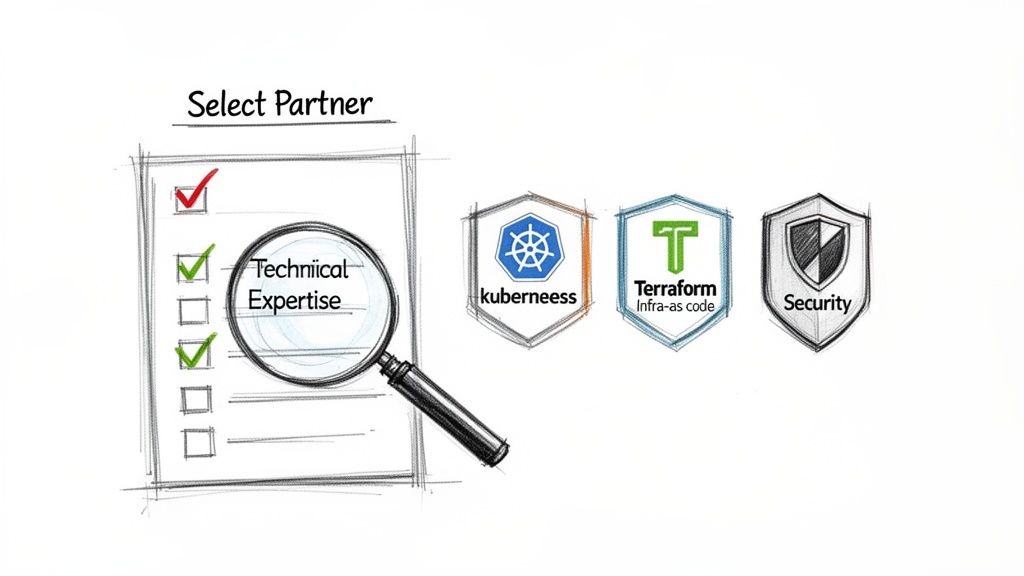
First, you must validate their hands-on expertise in the specific technologies that are core to your roadmap. A general "cloud" proficiency is no longer sufficient. You need specialists who have deep, practical experience with the tools that will form the foundation of your modern infrastructure.
Probe these key technical domains:
- Container Orchestration: Do not simply ask if they "use" Kubernetes. Ask them to describe their process for designing and securing production-grade clusters. Can they discuss, in detail, complex topics like service mesh implementation (Istio vs. Linkerd), the development of custom Kubernetes operators, and the implementation of GitOps workflows with tools like Flux or Argo CD?
- Infrastructure as Code (IaC): Go beyond "do you use Terraform?" Ask how they structure reusable Terraform modules to promote consistency and reduce code duplication. How do they manage Terraform state for multiple environments and teams? How do they integrate policy-as-code tools like Open Policy Agent (OPA) to enforce security and compliance standards?
- Multi-Cloud Security: Get specific about their approach to unified security posture management. How do they implement identity federation across AWS, Azure, and GCP? What specific tools and techniques do they use for Cloud Security Posture Management (CSPM) and Cloud Workload Protection Platforms (CWPP) in a hybrid environment?
Assessing Engineering Methodologies
A top-tier partner brings more than just technical skills; they bring a mature, modern engineering methodology. Their process directly impacts the quality of the delivered work and, critically, your team's ability to operate and evolve the new environment after the engagement concludes.
A primary objective of any successful cloud consulting engagement should be to make your own team self-sufficient. This requires a partner who prioritizes knowledge transfer over creating long-term dependencies.
To evaluate this, ask detailed questions about their approach to knowledge transfer. Do they practice pair-programming with your engineers? Do they produce comprehensive, living documentation as a standard deliverable? A partner who operates in a "black box" is a major red flag and a common source of vendor lock-in. You should also verify their commitment to transparency. Do they provide direct access to shared project management boards, source code repositories, and CI/CD pipelines?
Evaluating Talent and Compliance Know-How
Ultimately, a consulting firm's value is a direct function of the quality of its engineers. It is essential to understand their technical vetting process. How do they source, screen, and qualify their consultants? Do their interviews include hands-on technical challenges, system design sessions, and live coding exercises, or do they rely on certifications? The rigor of their process is a direct indicator of the quality of talent that will be assigned to your project.
Furthermore, compliance cannot be an afterthought. Your partner must have demonstrable, hands-on experience with the specific regulatory frameworks relevant to your business, whether that's HIPAA, PCI DSS, or GDPR. As part of your evaluation, it is wise to understand how they can support your broader security and audit needs, which often overlaps with knowing How to Choose From the Top IT Audit Companies for future validation of your cloud environment.
Conducting this level of due diligence ensures you find more than a contractor. The software consulting market is projected to grow from USD 380.26 billion in 2026 to USD 801.43 billion by 2031. By asking these tough, technical questions, you can identify a true partner capable of delivering a successful and sustainable cloud transformation.
Consulting Partner Evaluation Checklist
Use this checklist to systematically compare potential partners and ensure you're covering all the critical bases.
| Evaluation Criteria | What to Look For | How OpsMoon Delivers |
|---|---|---|
| Technical Depth | Deep, hands-on experience in Kubernetes, IaC (Terraform), and multi-cloud security. Ability to discuss complex scenarios. | Our Experts Matcher connects you with pre-vetted specialists who have proven, deep expertise in these exact technologies. |
| Engineering Process | A transparent methodology focused on knowledge transfer, pair-programming, and comprehensive documentation. | We prioritize co-development and create "living documentation" to ensure your team is fully enabled, not dependent. |
| Talent Quality | A rigorous, multi-stage vetting process that includes hands-on coding challenges and system design interviews. | Our vetting is intense. Only the top 3% of engineers pass our practical, real-world technical assessments. |
| Compliance Expertise | Demonstrable experience with industry-specific regulations (HIPAA, PCI, etc.) and a proactive approach to security. | We match you with consultants who have direct experience navigating the compliance landscape of your specific industry. |
| Engagement Flexibility | A range of engagement models (project-based, dedicated team, hourly) to fit your budget and project needs. | From fixed-scope projects to on-demand expert access, our flexible models adapt to your requirements. |
| Business Acumen | The ability to connect technical solutions directly to business outcomes, ROI, and your long-term strategic goals. | Our free planning session starts with your business goals, ensuring every technical decision serves a strategic purpose. |
Making a thoughtful, informed decision here will pay dividends for years to come, setting you up with a partner who not only builds but also empowers.
Frequently Asked Questions
Even the most well-architected cloud transformation plan will raise critical questions for technical leaders. This section addresses some of the most common technical challenges and concerns that arise during the journey to the cloud.
What Are the Most Common Technical Mistakes in a Cloud Migration?
Most organizations encounter the same technical pitfalls. The most significant errors almost always stem from inadequate planning and a fundamental misunderstanding of the operational shifts required to run systems in the cloud.
One of the most damaging mistakes is improper network architecture planning. A poorly designed VPC/VNet structure can lead to high latency, excessive data transfer costs, and critical security vulnerabilities. Teams also consistently underestimate data gravity—the technical and financial difficulty of moving large datasets. This results in performance bottlenecks and unexpected egress costs when cloud-based applications need to frequently access data from on-premise systems.
Another classic error is adopting a blanket "lift-and-shift" strategy. Migrating a monolithic application as-is to the cloud without modification means it cannot leverage cloud-native features like auto-scaling or self-healing. This results in poor performance, low resilience, and high operational costs, negating the primary benefits of the migration.
However, the single most critical error we see is the failure to implement Infrastructure as Code (IaC) rigorously from day one. Without a declarative tool like Terraform, your cloud environment will inevitably suffer from configuration drift, becoming an inconsistent and unmanageable collection of manually configured resources. This makes it impossible to scale reliably and securely, undermining the entire value proposition of the cloud.
How Can We Control Costs During a Cloud Transformation?
Effective cloud cost management, or FinOps, is an engineering discipline, not a finance-led accounting exercise. True cost control is built on three technical pillars: visibility, accountability, and automation.
The foundation is resource right-sizing. This involves analyzing performance metrics from observability tools like Prometheus or native cloud monitoring services to ensure that compute instances have the exact CPU, memory, and IOPS they require—and no more. Systemic over-provisioning is the single largest contributor to wasted cloud spend.
Beyond that, a mature FinOps practice incorporates several key technical habits:
- Implement Strict Resource Tagging: Enforce a mandatory tagging policy for all cloud resources via automation and policy-as-code. This is non-negotiable. Tagging allows you to precisely attribute costs to specific teams, projects, or application features, enabling granular cost visibility and accountability.
- Automate Shutdowns: Implement automated scripts or use managed services to shut down non-production environments (e.g., development, staging, QA) during non-business hours. This simple action can reduce non-production compute costs by 30-40%.
- Leverage Savings Plans: For predictable, steady-state workloads, strategically purchase Reserved Instances (RIs) or Savings Plans. Committing to one- or three-year terms for consistent compute usage can yield discounts of up to 72% compared to on-demand pricing.
The objective is not merely to reduce costs but to build a culture where engineering teams are empowered with cost data and feel accountable for the financial impact of their architectural and operational decisions.
Is a Multi-Cloud Strategy Always Better?
A multi-cloud strategy is often presented as a panacea, but it is not a universally applicable solution. While it can offer benefits like mitigating vendor lock-in and allowing for best-of-breed service selection, it introduces significant technical and operational complexity that can overwhelm unprepared teams.
Operating a multi-cloud environment requires a high degree of engineering maturity in several key domains:
- Unified Security: How do you enforce consistent security policies, identity management, and threat detection across disparate cloud platforms with different APIs and control planes?
- Cross-Cloud Networking: Establishing secure, low-latency, and cost-effective connectivity between different cloud providers is a complex networking challenge.
- Identity and Access Management (IAM): Federating user identities and enforcing consistent permissions across multiple clouds without creating security gaps is a non-trivial architectural task.
- Centralized Observability: Achieving a "single pane of glass" for monitoring, logging, and tracing across different cloud environments requires significant investment in tooling and integration.
For most organizations, particularly those early in their cloud journey, the most prudent approach is to achieve deep expertise and operational excellence on a single cloud platform first. A multi-cloud strategy should be a deliberate, strategic decision driven by a specific and compelling business or technical requirement—such as regulatory constraints or the need for a unique service offered by another provider. If the "why" is not crystal clear, the added complexity will almost certainly outweigh the perceived benefits.
Ready to navigate these complexities with a team that's been there before? OpsMoon is here to help. We connect you with elite, pre-vetted cloud and DevOps engineers who can accelerate your transformation and make sure you sidestep these common pitfalls. It all starts with a free, no-obligation work planning session to build a clear, actionable roadmap for your cloud journey.