
How to Hire and Leverage an Expert Cloud DevOps Consultant
 By opsmoon
A technical guide to hiring a cloud devops consultant. Learn to vet skills, define project scope, and measure the ROI of your DevOps initiatives.
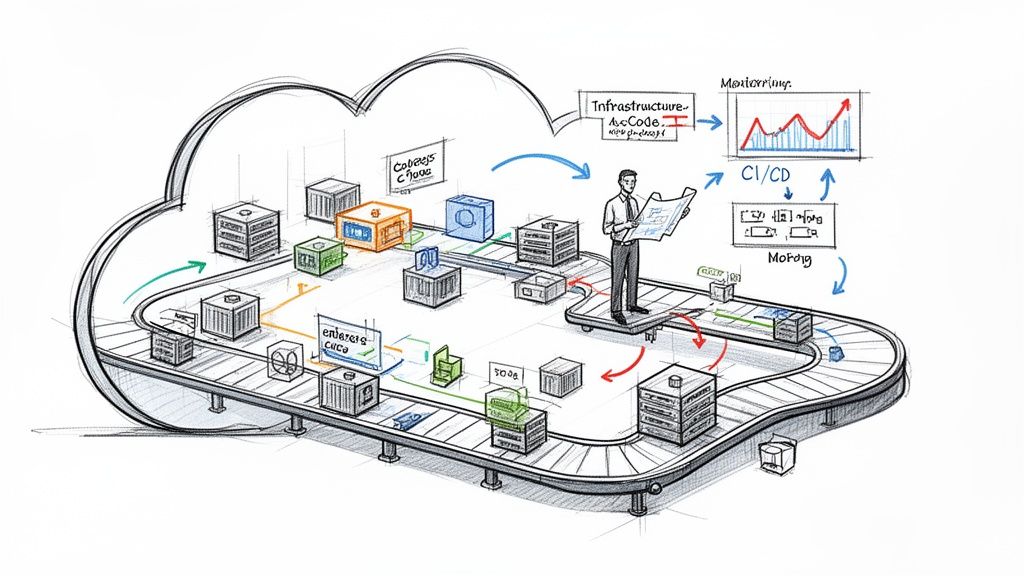
A Cloud DevOps Consultant is not just an advisor; they are the hands-on technical architect and engineer for your entire software delivery lifecycle. They design, build, and optimize the automated systems that directly determine your organization's velocity, reliability, and cloud expenditure. They are the specialists who construct the high-performance factory floor for your code.
This critical, hands-on expertise is why the DevOps consulting market is projected to surge from $8.6 billion in 2025 to an estimated $16.9 billion by 2033. Organizations that engage these experts report tangible outcomes, including up to 30% savings on infrastructure costs and shipping code 60% faster. You can read more about the growth of the DevOps consulting market and its impact.
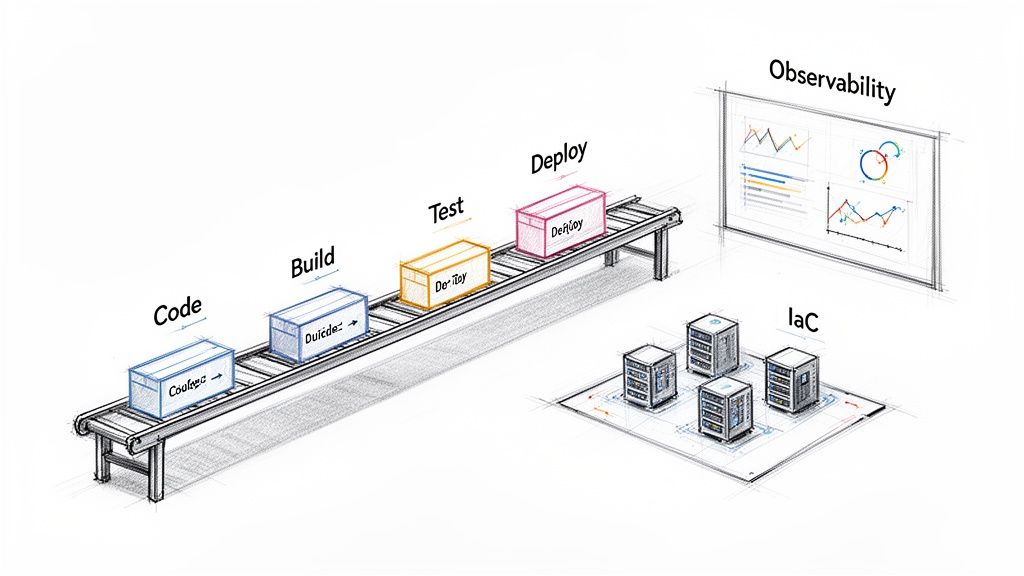
So what does this "factory" actually look like from a technical standpoint? It breaks down into three core engineering domains.
The Automated Code Assembly Line
At the core is the CI/CD (Continuous Integration/Continuous Delivery) pipeline. This is the automated system that compiles, tests, secures, and deploys code from a Git commit to a live production environment with minimal human intervention.
A consultant doesn't just install a tool; they engineer a multi-stage pipeline that executes critical quality and security gates:
- Code Compilation & Static Analysis: Compiling source code and running tools like SonarQube or ESLint to catch code quality issues and bugs before runtime.
- Automated Testing: Executing a suite of unit tests, integration tests, and security scans (SAST/DAST) to validate functionality and identify vulnerabilities.
- Secure Packaging: Building the application into a standardized, immutable artifact, typically a minimal-footprint Docker container using multi-stage builds.
- Deployment Strategy Execution: Implementing and automating advanced deployment patterns like blue-green, canary, or rolling updates to ensure zero-downtime releases.
The Resilient, Code-Defined Factory Floor
Next, a consultant constructs the underlying cloud infrastructure using Infrastructure as Code (IaC). With tools like Terraform or Pulumi, they define every component—VPCs, subnets, security groups, IAM roles, compute instances, and databases—in declarative, version-controlled configuration files.
This fundamentally transforms your infrastructure from a manually-configured, fragile asset into a software product.
Your infrastructure becomes a predictable, auditable, and repeatable blueprint. An entire production environment can be programmatically provisioned, updated, or destroyed in minutes. This is the bedrock of effective disaster recovery, ephemeral testing environments, and rapid scalability.
The Sophisticated Observability Control Room
Finally, every modern platform requires a control room. A consultant implements a comprehensive observability stack for deep, proactive insight into system health and performance. This goes far beyond legacy monitoring of CPU and memory.
They integrate and configure tools like Prometheus for time-series metrics, Grafana for visualization, and OpenTelemetry for distributed tracing. This setup enables engineering teams to diagnose the root cause of latency or errors across complex microservices, moving from reactive alerting to proactive performance optimization.
To put it all together, here's a quick look at how these technical functions deliver tangible business value.
Core Competencies of a Cloud DevOps Consultant
| Technical Function | Key Deliverables | Business Impact |
|---|---|---|
| CI/CD Pipeline Automation | Multi-stage, fully automated build, test, and deployment pipelines (e.g., Jenkins, GitLab CI, GitHub Actions). | Increased Velocity: Reduce lead time for changes from weeks to hours. Ship features faster and more frequently. Minimize manual deployment errors. |
| Infrastructure as Code (IaC) | Modular, reusable, and version-controlled infrastructure definitions (e.g., Terraform, CloudFormation, Pulumi). | Cost Optimization & Reliability: Eliminate configuration drift, enable one-click disaster recovery, and optimize cloud spend via automated provisioning/de-provisioning. |
| Observability & Monitoring | Integrated metrics, logging, and tracing stacks (e.g., Prometheus, Grafana, OpenTelemetry, ELK Stack). | Improved Uptime & MTTR: Proactively identify and resolve performance bottlenecks before they impact customers. Drastically reduce Mean Time to Recovery. |
| Cloud Security & Compliance (DevSecOps) | Automated security scanning (SAST, DAST, SCA) in pipelines, policy-as-code (e.g., OPA), secrets management (e.g., Vault). | Reduced Risk & Audit Overhead: Embed security into the development lifecycle ("Shift Left"). Automate compliance evidence gathering for standards like SOC 2 or ISO 27001. |
| Containerization & Orchestration | Optimized Dockerfiles, Kubernetes (K8s) cluster architecture, Helm charts, and custom operators. | Enhanced Scalability & Efficiency: Standardize application runtime environments. Improve resource utilization and simplify the management of distributed microservices. |
By architecting these interconnected systems, a Cloud DevOps consultant creates a robust, automated, and observable platform that empowers your engineering teams to focus on building business value.
The Technical Skill Matrix for Vetting Candidates
When hiring an elite cloud DevOps consultant, you must evaluate their ability to solve complex technical problems, not just recite buzzwords. This technical matrix is a blueprint for vetting a candidate's practical, hands-on capabilities in building and managing modern cloud-native systems.
Genuine mastery of at least one major cloud provider is the non-negotiable foundation. This means deep architectural knowledge, not just surface-level familiarity with the console.
Core Cloud and Infrastructure Proficiency
A qualified consultant must have production-grade experience with one of the "big three" public clouds, understanding the nuanced trade-offs between their services.
- Cloud Provider Mastery (AWS, Azure, or GCP): Test their architectural depth. Ask them to design a highly available, multi-AZ architecture for a stateful web application. A strong candidate will justify their choice of AWS RDS Multi-AZ over a self-managed database on EC2, or explain the networking implications of using Azure Private Link versus VNet Peering.
- Infrastructure as Code (IaC) Fluency: Terraform is the de facto standard. A senior consultant should be able to explain how to structure Terraform code using modules for reusability and composition. Ask them to describe strategies for managing remote state securely (e.g., using S3 with DynamoDB for locking) and their experience with tools like Terragrunt for managing multiple environments. Bonus points for proficiency in Pulumi or the AWS CDK.
- Containerization and Orchestration: Expert-level knowledge of Docker and Kubernetes is mandatory. Can they write a lean, secure, multi-stage Dockerfile that minimizes image size and attack surface? Can they design a Kubernetes deployment manifest that correctly configures readiness/liveness probes, resource requests/limits, and pod anti-affinity rules for high availability? These are the practical skills that matter.
Automation and Observability Skills
Infrastructure is just the foundation. A consultant's true value is demonstrated through their ability to automate processes and build self-healing systems with deep observability.
A consultant who cannot automate themselves out of a job is missing the point of DevOps. Their goal should be to build self-healing, automated systems that reduce manual toil, not create dependencies on their continued presence.
Look for deep, practical experience in these domains:
- Scripting for Automation: Proficiency in a language like Python or Go is essential for writing custom automation, interacting with cloud provider SDKs, and building CLI tools. Ask them for a specific example of a script they wrote to automate a tedious operational task, like rotating credentials or pruning old snapshots.
- CI/CD Pipeline Architecture: They must have designed and implemented CI/CD pipelines. Ask about their experience with securing pipelines, managing secrets, caching dependencies for faster builds, and implementing GitOps workflows with tools like ArgoCD or Flux. Their knowledge should span tools like GitHub Actions or GitLab CI.
- Building the Observability Stack: A consultant must have hands-on experience implementing the three pillars of observability. Ask them how they would instrument an application using OpenTelemetry to capture traces. They should be able to write PromQL queries in Prometheus to calculate SLIs like error rates and p99 latency, and build insightful dashboards in Grafana.
Beyond the Tech Stack: Soft Skills and Certifications
Technical expertise alone is insufficient. A great cloud DevOps consultant must be able to translate complex technical decisions into business impact and mentor teams effectively. Look for evidence of systems thinking and clear, concise communication.
Certifications can validate foundational knowledge, though they are secondary to proven experience.
- AWS Certified DevOps Engineer – Professional: This certification validates deep expertise in provisioning, operating, and managing distributed application systems on the AWS platform.
- Certified Kubernetes Administrator (CKA): This performance-based exam proves a candidate possesses the hands-on, command-line skills to administer production-grade Kubernetes clusters.
Ultimately, you are looking for a practitioner with a rare combination of deep technical ability and the strategic communication skills needed to drive meaningful organizational change. To learn more about identifying these experts, see our guide on effective consultant talent acquisition.
Identifying the Right Time to Hire a Consultant
Engaging a cloud DevOps consultant is a strategic decision, not a reactive measure. Identifying the right moment to bring in an expert is as crucial as selecting the right person. Proper timing ensures the engagement is a high-ROI investment that accelerates your roadmap and fortifies your technical platform.
The need for this expertise is widespread. The global Cloud Professional Services market is forecast to grow from $30.5 billion in 2025 to $130.4 billion by 2034, driven by companies seeking to manage cloud complexity and accelerate innovation.
Common Technical Triggers for Hiring an Expert
Certain technical anti-patterns are clear indicators that your team's cognitive load is too high and an external expert is needed. These are not minor inconveniences; they are symptoms of systemic issues that erode engineering velocity and increase operational risk.
Here are the classic inflection points where a consultant provides immediate value:
- Deployment Frequency Stalls: Your team's deployment frequency has regressed from multiple times a week to a high-ceremony, bi-weekly or monthly event. This signals friction in your CI/CD process—brittle tests, manual steps, or slow builds—that a consultant can diagnose and automate.
- Manual Rollbacks Are the Norm: If a failed deployment triggers a "war room" and requires manual database changes or server logins to roll back, your release process is broken. A consultant can implement automated, reliable deployment strategies like blue-green or canary releases with automatic rollback triggers.
- Cloud Costs Are Spiraling Out of Control: Your monthly cloud bill is increasing without a clear correlation to business growth. An expert can implement FinOps practices, use IaC to enforce resource tagging, identify idle or oversized resources, and establish automated cost monitoring and alerting.
Strategic Goals That Demand Specialized Knowledge
Sometimes, the trigger is an opportunity, not a problem. You are ready to adopt a transformative technology or methodology, but your team lacks the deep, production-level experience to execute it successfully.
A consultant acts as a catalyst here. They bring in proven patterns and best practices, helping your team sidestep common pitfalls and massively shorten the learning curve. This ensures the project actually delivers value instead of becoming a technical dead end.
Key strategic initiatives that warrant a consultant include:
- Migrating to Kubernetes: Adopting a container orchestrator like Kubernetes is a significant architectural shift. A consultant ensures your cluster is designed for security, scalability, and operational efficiency from day one, covering aspects like networking (CNI), ingress, and RBAC.
- Implementing a Real DevSecOps Strategy: You want to "shift security left," but your developers aren't security experts. A consultant can integrate automated security tooling (SAST, DAST, SCA, container scanning) directly into the CI/CD pipeline, making security an automated, transparent part of the development workflow.
- Building a True Observability Platform: Moving beyond basic CPU/memory monitoring to a rich stack with metrics, logs, and traces requires specialized expertise. A consultant can architect and implement a platform that enables you to debug production issues in minutes, not hours.
When considering external help, it is vital to understand the difference between staff augmentation vs consulting. Staff augmentation adds manpower; consulting provides expert ownership of a specific outcome. A cloud DevOps consultant is hired to drive a tangible transformation.
A Step-by-Step Technical Evaluation Checklist
Hiring a cloud DevOps consultant requires a rigorous, hands-on process that validates their ability to architect and implement solutions, not just talk about them. This technical checklist is designed to help engineering leaders identify true practitioners who can deliver value from day one.
Step 1: Architect the Scope
Before screening candidates, you must define the problem with technical precision. A vague objective leads to a vague outcome.
Create a "Current State vs. Future State" technical document. This serves as the blueprint for the engagement.
- Current State: Quantify the pain points. Instead of "deployments are slow," specify: "Our monolithic application deployment takes 4 hours, requires manual SQL schema updates, and has a 15% change failure rate, necessitating frequent, disruptive rollbacks."
- Future State: Define success with measurable, technical KPIs. For example: "Achieve a fully automated CI/CD pipeline for our containerized microservices on Kubernetes that executes in under 15 minutes with a change failure rate below 5% and a Mean Time to Recovery (MTTR) of less than 30 minutes."
This document becomes your North Star, providing a clear definition of "done" for both you and the candidate.
Step 2: Design a Practical Technical Challenge
Abandon abstract whiteboard problems. The most effective evaluation is a small-scale, hands-on challenge that mirrors the actual work. This reveals their technical proficiency, problem-solving approach, and attention to detail.
A robust technical challenge should include:
- A Sample Application: Provide a simple web application (e.g., a basic Node.js or Python API) in a Git repository.
- A Clear, Bounded Task: Ask the candidate to:
- Containerize the application using a secure, multi-stage
Dockerfile. - Write Terraform code to provision the necessary cloud infrastructure (e.g., a container registry and a serverless container service).
- Create a CI pipeline script (GitHub Actions or GitLab CI) that builds the image, runs linters/tests, pushes to the registry, and deploys the application.
- Containerize the application using a secure, multi-stage
- A Thorough Code Review: Evaluate the solution's quality, not just its functionality. Did they minimize the Docker image size? Is the Terraform code modular and idempotent? Is the pipeline script efficient and readable?
This exercise tests core competencies—Docker, IaC, CI/CD—in a realistic context.
The goal of a technical challenge isn't to trip someone up. It's to create a collaborative scenario where you can see how they think. The way they ask questions, communicate trade-offs, and justify their decisions is often more telling than the final code itself.
Step 3: Ask About Failures and Trade-Offs
During the interview, move beyond success stories. The most insightful discussions revolve around failures, production outages, and complex trade-off decisions. This is where you uncover true seniority.
Ask targeted, open-ended questions that probe their reasoning:
- "Describe the most significant production outage you were involved in. Walk me through the incident response, the post-mortem process, and the specific technical and process changes you implemented to prevent recurrence."
- "Describe a time you had to choose between a managed cloud service (e.g., AWS RDS) and a self-hosted alternative on VMs. What factors did you consider (cost, operational overhead, performance), and how did you justify your final recommendation?"
- "Tell me about a time a major infrastructure migration or platform upgrade went wrong. What was the root cause, what did you learn, and how did it change your approach to future projects?"
Listen for answers that demonstrate technical depth, ownership, and an understanding of the business context.
Step 4: Verify Past Work and Impact
Validate the candidate's claims. A top-tier consultant will have a portfolio of work (e.g., public GitHub repositories, blog posts) or can speak with extreme detail about their specific contributions to past projects. During reference checks, ask specific, technical questions to their former managers or peers.
Use a weighted scorecard to standardize your evaluation and mitigate bias.
Consultant Evaluation Scorecard
| Evaluation Criteria | Weight (1-5) | Candidate A Score | Candidate B Score | Notes |
|---|---|---|---|---|
| Technical Challenge Performance | 5 | 4 | 3 | Candidate A's Dockerfile was optimized for size and security. |
| Cloud Platform Expertise (AWS/GCP/Azure) | 5 | 5 | 4 | B had less experience with our primary cloud, AWS. |
| CI/CD & Automation Skills | 4 | 4 | 5 | B showed deeper knowledge of advanced GitLab CI features. |
| Infrastructure as Code (Terraform/Pulumi) | 4 | 5 | 3 | A has extensive production Terraform experience. |
| Problem-Solving & Critical Thinking | 5 | 4 | 4 | Both candidates demonstrated strong analytical skills. |
| Communication & Collaboration | 3 | 5 | 4 | A was exceptionally clear in explaining complex trade-offs. |
| Culture Fit & Alignment | 2 | 4 | 5 | B's approach to teamwork seems a perfect fit for our org. |
| Total Weighted Score | – | 4.5 | 4.0 | – |
This structured process ensures you hire a consultant who can not only strategize but also execute, building the resilient, automated systems your business requires. For more on this, our production readiness checklist provides a comprehensive framework.
Sample Project Roadmaps for Common Engagements
To move from abstract requirements to concrete execution, let's outline what a cloud DevOps consultant's engagement looks like in practice. A successful project is not an open-ended arrangement; it is a structured initiative with well-defined phases, technical deliverables, and measurable milestones.
These technical playbooks illustrate what to expect week-by-week for common, high-impact projects. They provide a clear framework for collaboration and progress tracking.
First, however, a solid evaluation is key to ensuring you've chosen a consultant capable of executing these roadmaps.
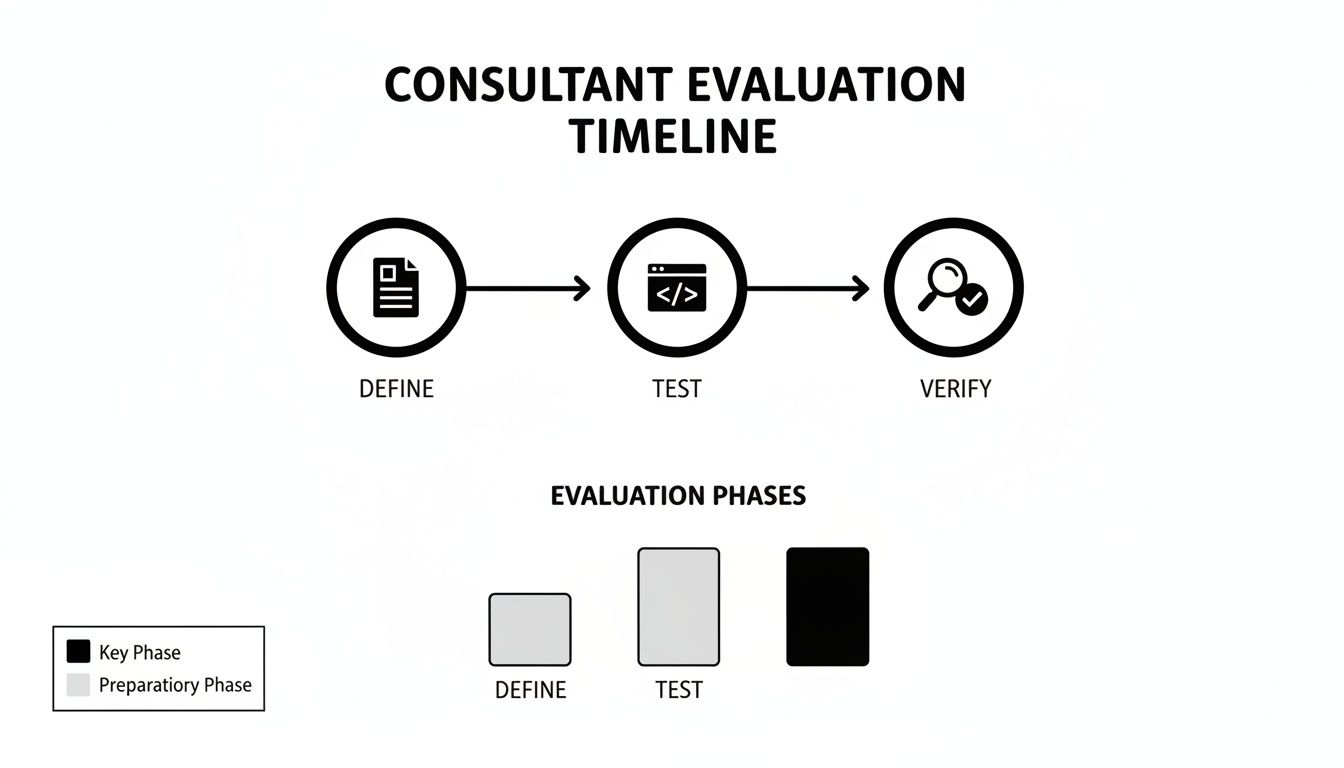
This process ensures that the scope is defined, capabilities are tested, and the consultant is verified before the project begins.
30 Day CI/CD Pipeline Build
Objective: A rapid, focused engagement to build a production-ready, automated CI/CD pipeline for a new or existing service, dramatically reducing lead time for changes.
- Week 1: Discovery and Scaffolding
- Milestone: Finalize pipeline requirements and select the toolchain (e.g., GitHub Actions, GitLab CI).
- Deliverables: An optimized, multi-stage
Dockerfilefor the service; initial pipeline configuration files (.yml); and a secure secrets management strategy (e.g., using Vault or native cloud KMS).
- Weeks 2-3: Pipeline Construction and Integration
- Milestone: Implement and integrate all core pipeline stages: build, test, and security scanning.
- Deliverables: A fully functioning pipeline that automatically triggers on code commits, runs unit/integration tests, performs static analysis (SAST), and scans container images for known vulnerabilities (SCA).
- Week 4: Deployment Automation and Handover
- Milestone: Automate deployment to staging and production environments using a zero-downtime strategy.
- Deliverables: A production-ready pipeline with promotion triggers (e.g., manual approval for production), comprehensive documentation, and a knowledge transfer session with the engineering team.
60 Day Infrastructure as Code Migration
Objective: Migrate an existing, manually-managed application infrastructure to Terraform, establishing a single source of truth that is version-controlled, auditable, and reproducible.
- Weeks 1-2: Audit and Architectural Design
- Milestone: Conduct a thorough audit of the existing cloud infrastructure and design a modular, scalable Terraform architecture.
- Deliverables: A detailed "current vs. future state" architecture diagram; a defined Terraform project structure with a plan for module composition; a strategy for importing existing resources into Terraform state.
- Weeks 3-5: IaC Development and Validation
- Milestone: Write and test the Terraform code for all infrastructure components (networking, compute, storage, IAM).
- Deliverables: A complete set of reusable Terraform modules; a CI/CD pipeline for validating Terraform code (
terraform fmt,validate,plan); a secure remote backend configuration for state management. For more on this, see our guide on cloud migration consultation.
- Weeks 6-8: Phased Cutover and Optimization
- Milestone: Execute a carefully planned, low-risk migration from the manually-managed infrastructure to the new Terraform-managed environment.
- Deliverables: A successfully migrated production environment; documentation and training on the new IaC workflow; implementation of cost-saving policies (e.g., automated shutdown of non-production environments).
90 Day Kubernetes and Observability Implementation
Objective: Architect and deploy a production-grade Kubernetes platform and integrate a comprehensive observability stack to enable proactive performance management.
This project shifts the organization's operational posture from reactive ("is the system down?") to proactive ("why is this API call 50ms slower?"), providing deep insights rather than just basic alerts.
- Month 1: Kubernetes Foundation
- Milestone: Provision a secure, scalable Kubernetes cluster (EKS, GKE, or AKS) using Infrastructure as Code.
- Deliverables: A production-ready cluster with a hardened control plane, proper network policies, role-based access control (RBAC), and a configured ingress controller.
- Month 2: Application Onboarding and CI/CD Integration
- Milestone: Containerize the target application and create the necessary Kubernetes manifests for deployment.
- Deliverables: A set of version-controlled Helm charts for the application; a CI/CD pipeline that automatically builds, tests, and deploys the application to the Kubernetes cluster using a GitOps controller like ArgoCD.
- Month 3: Observability Stack Integration
- Milestone: Deploy and configure a full observability stack using tools like Prometheus for metrics, Grafana for dashboards, Loki for logging, and OpenTelemetry for tracing.
- Deliverables: Custom Grafana dashboards visualizing key application SLIs/SLOs; distributed tracing implemented in the application; a centralized logging solution; training for the engineering team on how to use these new tools to debug and optimize their services.
How to Measure the ROI of Your DevOps Consultant
Hiring a cloud DevOps consultant is a significant investment that must be justified with measurable returns. To demonstrate value to stakeholders, you need a framework that translates technical improvements into tangible business outcomes, moving beyond anecdotal evidence to hard data.
The industry-standard DORA metrics are the starting point. These four key performance indicators provide a quantitative, data-driven assessment of your software delivery capabilities, creating a clear "before and after" picture of a consultant's impact.
Quantifying Engineering Velocity and Stability
DORA metrics offer a universal language for engineering performance. A skilled consultant will instrument your CI/CD and deployment systems to track these metrics automatically, providing objective proof of improvement.
- Deployment Frequency: How often does your organization successfully release to production? A consultant's work should increase this from monthly or weekly to multiple times per day for elite teams, directly increasing the rate of value delivery.
- Lead Time for Changes: What is the elapsed time from code commit to code successfully running in production? By removing bottlenecks in the CI/CD pipeline, a consultant can slash this time from weeks to hours, accelerating the entire development lifecycle.
- Mean Time to Recovery (MTTR): How long does it take to restore service after a production impairment? Implementing better monitoring, automated rollbacks, and IaC for rapid environment rebuilds can reduce MTTR from hours to minutes, minimizing customer impact.
- Change Failure Rate: What percentage of deployments to production result in a degraded service and require remediation? By improving automated testing and implementing progressive delivery strategies, a consultant should drive this rate down, increasing system reliability.
These metrics are not just internal engineering vanity stats. A lower Change Failure Rate translates directly to fewer customer support tickets. A shorter Lead Time for Changes means the sales team can promise features that engineering can actually deliver in the same quarter.
Tracking the Impact on Your Bottom Line
Beyond engineering metrics, a consultant's work must demonstrably affect financial and business KPIs. This connection is crucial for calculating the full ROI and aligns with the transformative cloud computing business benefits that leadership expects.
The global DevOps market is projected to reach $86.16 billion by 2034 because companies that master it see real financial gains, saving an average of 30% on infrastructure and cutting deployment times by 60%. For more details, explore these DevOps statistics and their impact.
Track these critical business KPIs:
- Reduction in Cloud Spend (TCO): An effective consultant will immediately apply FinOps principles, using IaC to right-size resources, eliminate waste, and leverage cost-saving plans. Monitor your monthly Total Cost of Ownership (TCO); you should see a measurable decrease in your cloud bill.
- Improved Developer Productivity: Measure the time developers spend on operational toil versus feature development. By automating infrastructure provisioning, deployments, and testing, a consultant frees up expensive engineering hours to be spent on innovation, not maintenance.
- Increased System Uptime and SLO Adherence: Track your Service Level Objectives (SLOs) and overall system availability. Every minute of downtime has a direct revenue or reputational cost. A consultant's work on system resilience and automated recovery directly translates into higher availability and customer satisfaction.
Frequently Asked Questions
Engaging an external expert often raises important questions for technical leadership. Here are answers to the most common queries CTOs and engineering managers have when considering a cloud DevOps consultant.
What Is the Typical Engagement Length for a Consultant?
Engagement length is directly tied to project scope. Most engagements fall into predictable timeframes:
- 30 to 90 days: For highly focused projects with a clear scope, such as building a specific CI/CD pipeline, performing a cloud cost optimization audit, or migrating a single application to Terraform.
- 3 to 6 months: For more substantial platform builds, like a complete migration to Kubernetes or the implementation of a comprehensive observability stack from the ground up.
- Ongoing (Fractional): For organizations requiring continuous strategic guidance through a complex, multi-year digital transformation, a long-term, part-time advisory role is common.
How Should We Onboard a Cloud DevOps Consultant?
Onboard them as you would a new senior staff engineer: with speed and trust. The objective is to empower them to be productive immediately.
The most common mistake is restricting a consultant's access due to misplaced caution, which only delays their ability to diagnose and deliver. On day one, grant them read-only access to your cloud accounts, source code repositories, and observability tools. This allows them to begin discovery and architectural analysis independently.
A streamlined onboarding checklist includes:
- System Access: Provision access to all relevant platforms (cloud provider, Git, CI/CD tools, project management).
- Documentation Review: Provide direct links to architecture diagrams, existing runbooks, and recent post-mortems.
- Key Introductions: Schedule brief meetings with key technical leads, product managers, and other stakeholders they will be collaborating with.
What Differentiates a Great Consultant from a Good One?
A good consultant executes the tasks assigned. A great cloud DevOps consultant operates as a strategic partner. They proactively identify underlying systemic problems you didn't know you had and connect every technical decision to a business objective.
They don't just build a CI/CD pipeline; they analyze why the current release process is slow and articulate how improving it will accelerate time-to-market and reduce developer burnout. Great consultants are exceptional systems thinkers and communicators. Most importantly, they focus on knowledge transfer, aiming to upskill your team and build durable, automated systems that reduce long-term dependency. Their primary goal is to make themselves obsolete.
At OpsMoon, we connect you with the top 0.7% of global DevOps talent to build the resilient, scalable systems your business needs. Start with a free work planning session to map out your technical roadmap and get matched with an expert who can deliver. Learn more about our DevOps services at OpsMoon.