
Why Modern Teams Need a CI CD Consultant
 By opsmoon
Discover what a CI CD consultant does, the skills they need to succeed, and how to hire the right expert to accelerate your software delivery pipeline.
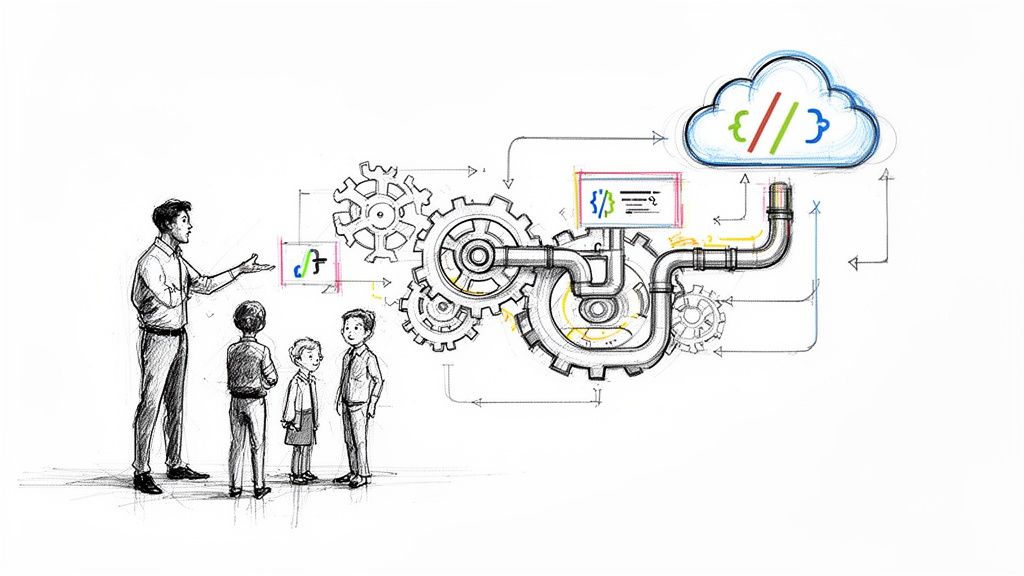
A CI/CD consultant is a specialized engineer who architects, builds, and optimizes the automated workflows that move code from a developer's machine to production. They diagnose and resolve bottlenecks in the software delivery lifecycle, transforming slow, error-prone manual processes into fast, repeatable, and secure automated pipelines. Their core objective is to increase deployment frequency, reduce change failure rates, and accelerate the feedback loop for engineering teams.
The High-Stakes World of Modern Software Delivery
The pressure on engineering teams to accelerate feature delivery while maintaining system stability is relentless. Sluggish deployments, high change failure rates, and developer burnout are not just technical issues; they are symptoms of a suboptimal software delivery process that directly impacts business velocity and competitive advantage. This inefficiency creates a significant performance gap between average teams and high-performing organizations.
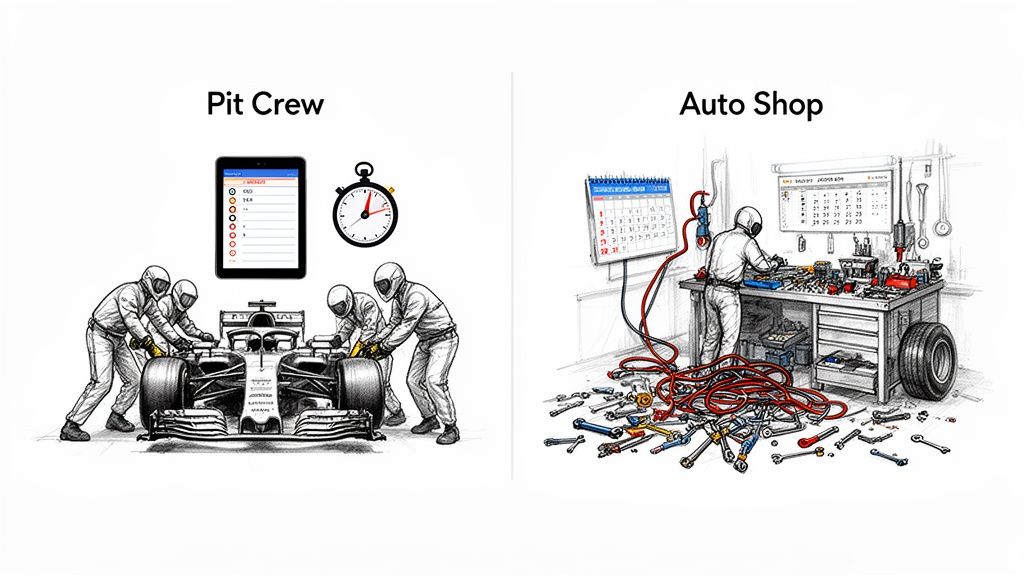
From the Local Garage to the F1 Pit Crew
A manual deployment process is analogous to a local auto shop: functional but inefficient. Each task—compiling code, running tests, configuring servers, deploying artifacts—is performed manually, introducing significant latency and a high probability of human error. Each release becomes a bespoke, high-risk event with unpredictable outcomes.
An automated CI/CD pipeline, by contrast, operates like a Formula 1 pit crew. Every action is scripted, automated, and executed with precision. This level of operational excellence is achieved through rigorous process engineering, specialized tooling, and a deep understanding of system architecture. The objective is not just to deploy code but to do so with maximum velocity and reliability.
A CI/CD consultant is the strategic architect who re-engineers your software delivery mechanics, transforming your process into an elite, high-performance system designed for speed, safety, and repeatability.
This transformation is now a business necessity. The global market for continuous integration and delivery tools was valued at USD 1.7 billion in 2024 and is projected to reach USD 4.2 billion by 2031, signaling a decisive industry shift away from manual methodologies.
Manual Deployment vs Automated CI CD Pipeline
| Aspect | Manual Deployment | Automated CI CD Pipeline |
|---|---|---|
| Process | Sequential, manual steps for build, test, and deploy. Prone to human error (e.g., forgotten config change, wrong artifact version). | Fully automated, parallelized stages triggered by code commits. Governed by version-controlled pipeline definitions (e.g., gitlab-ci.yml, Jenkinsfile). |
| Speed | Slow, often taking days or weeks. Gated by manual approvals and task handoffs. | Extremely fast, with lead times from commit to production measured in minutes or hours. |
| Reliability | Inconsistent. Success depends on individual heroics and runbook accuracy. High Mean Time To Recovery (MTTR). | Highly consistent and repeatable. Every release follows the same auditable, version-controlled path. Low MTTR via automated rollbacks. |
| Feedback Loop | Delayed. Bugs are often found late in staging or, worse, in production by users. | Immediate. Automated tests (unit, integration, SAST) provide feedback directly on the commit or pull request, enabling developers to fix issues instantly. |
| Risk | High. Large, infrequent "big bang" releases are complex and difficult to roll back, increasing the blast radius of any failure. | Low. Small, incremental changes are deployed frequently, reducing complexity and making rollbacks trivial. Advanced deployment strategies (canary, blue-green) are enabled. |
Addressing Core Business Pain Points
A CI/CD consultant addresses critical business problems that manifest as technical friction. Their work directly impacts revenue, operational efficiency, and developer retention.
- Sluggish Time-to-Market: When features are "code complete" but sit in a deployment queue for weeks, the opportunity cost is immense. Competitors who can ship ideas faster gain market share. A consultant shortens this cycle by automating every step from merge to production.
- High Failure Rates: Constant production rollbacks and emergency hotfixes burn engineering capacity and erode customer trust. A consultant implements quality gates—automated testing, security scanning, and gradual rollouts—to catch defects before they impact users.
- Developer Burnout: Forcing skilled engineers to perform repetitive, manual deployment tasks is a primary driver of attrition. It also creates a knowledge silo where only a few "deployment gurus" can ship code. Understanding the evolving landscape of knowledge management and artificial intelligence is paramount for maintaining a competitive edge.
By instrumenting and optimizing the delivery pipeline, a CI/CD consultant provides a strategic capability: the ability to innovate safely and at scale.
The Anatomy of a CI/CD Consultant's Role
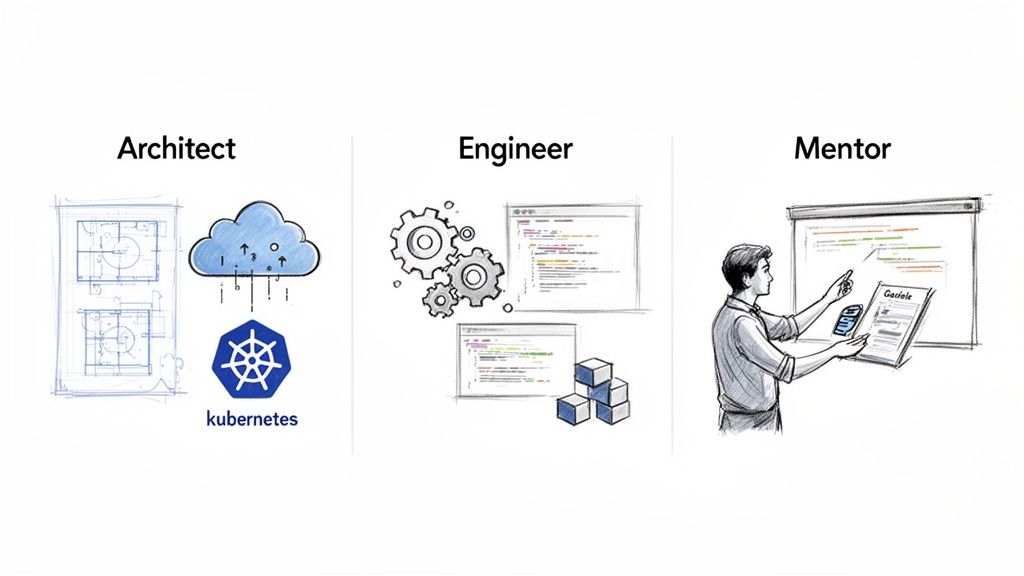
A top-tier CI/CD consultant operates across three distinct but interconnected roles: Pipeline Architect, Automation Engineer, and DevOps Mentor. This multi-faceted approach ensures that the solutions are not only technically sound but also sustainable and adopted by the internal team. They transition seamlessly from high-level system design to hands-on implementation and knowledge transfer.
The Pipeline Architect
As an architect, the CI/CD consultant designs the end-to-end software delivery blueprint. This strategic phase involves a thorough analysis of the existing technology stack, team structure, and business objectives to design a resilient, scalable, and secure delivery system.
The architect evaluates the specific context—whether it's a microservices architecture on Kubernetes, a serverless application, or a legacy monolith—and designs an appropriate pipeline structure. This includes defining build stages, test strategies (e.g., test pyramid implementation), artifact management, and deployment methodologies (e.g., canary vs. blue-green). They make critical decisions on workflow models, such as trunk-based development versus GitFlow, and define the quality and security gates that code must pass to progress to production. The architectural focus is on creating a system that is maintainable, observable, and adaptable to future needs.
The Automation Engineer
As an engineer, the consultant translates the architectural blueprint into a functioning, automated system. This is where high-level design meets hands-on-keyboard implementation, writing the code that automates the entire delivery process.
This hands-on work involves a range of technical implementations:
- Infrastructure as Code (IaC): Using tools like Terraform or Pulumi to define and manage cloud infrastructure declaratively. This eliminates manual configuration errors and ensures environments are reproducible.
- Pipeline Scripting: Implementing pipeline-as-code using the specific domain-specific language (DSL) of the chosen tool, whether it's YAML for GitHub Actions and GitLab CI or Groovy for a shared library in Jenkins.
- Tool Integration: Integrating disparate systems into a cohesive workflow. This includes scripting the integration of automated testing frameworks (Cypress, Selenium), security scanners (Snyk, Trivy), and artifact repositories (Artifactory) into the pipeline logic.
Technical Example: A common problem is a pipeline failure due to an end-of-life (EOL) dependency. An engineer would implement a solution by adding a step that uses
trivy fsor a similar tool to scan the project's lock file (package-lock.json,pom.xml). They would configure the job to fail the build if a dependency with a known EOL date is detected, preventing technical debt from entering the main branch.
An engineer might implement a GitOps workflow using ArgoCD to continuously reconcile the state of a Kubernetes cluster with a Git repository. Or they might optimize a Dockerfile with multi-stage builds and layer caching, reducing container image build times from 15 minutes to under two, which directly accelerates the feedback loop for every developer.
The DevOps Mentor
The consultant's final and most critical role is that of a mentor. A sophisticated pipeline is useless if the team is not equipped to use, maintain, and evolve it. The primary goal is to enable the internal team, ensuring the implemented solution delivers long-term value.
This mentorship is delivered through several channels:
- Conducting Workshops: Leading hands-on training sessions on new tools (e.g., "Intro to Terraform for Developers") and processes (e.g., "Our New Trunk-Based Development Workflow").
- Pair Programming: Working directly with engineers to solve real pipeline issues, transferring practical knowledge and debugging techniques.
- Establishing Best Practices: Authoring clear documentation, contribution guidelines (
CONTRIBUTING.md), and templated runbooks for pipeline maintenance and incident response. - Fostering a DevOps Culture: Advocating for principles of shared ownership, blameless post-mortems, and data-driven decision-making to bridge the gap between development and operations.
The engagement is successful when the internal team can confidently own and improve their delivery pipeline long after the consultant has departed.
The CI CD Consultant Technical Skill Matrix
Evaluating a CI/CD consultant requires moving beyond a tool-based checklist. True expertise lies in understanding the deep interplay between infrastructure, code, and process. An effective consultant possesses a T-shaped skill set, with deep expertise in CI/CD automation and broad knowledge across cloud, containerization, security, and software development practices.
The foundation for all CI/CD is mastery of modern version control systems, particularly Git. Git serves as the single source of truth and the trigger for all automated workflows. Without deep expertise in branching strategies, commit hygiene, and Git internals, any pipeline is built on an unstable foundation.
Cloud and Containerization Mastery
Modern CI/CD pipelines are ephemeral, dynamic, and executed on cloud infrastructure. A consultant’s proficiency in cloud and container technologies is therefore a prerequisite for building effective delivery systems.
- Cloud Platforms (AWS, GCP, Azure): Deep, practical knowledge of at least one major cloud provider is essential. This includes mastery of core services like IAM (for secure pipeline permissions), VPCs (for network architecture), and compute services (EC2, Google Compute Engine, AKS/EKS/GKE). An expert can design a cloud topology that is secure, cost-optimized, and scalable.
- Containerization (Docker): Consultants must be experts in crafting lean, secure, and efficient Dockerfiles. This skill directly impacts build performance and security posture. A bloated, insecure base image can slow down every single build and introduce vulnerabilities across all services.
- Orchestration (Kubernetes): Proficiency in Kubernetes extends beyond basic
kubectl apply. An expert consultant leverages the Kubernetes API to implement advanced deployment strategies like automated canary analysis with a service mesh (e.g., Istio) or progressive delivery using tools like Flagger, all orchestrated directly from the CI/CD pipeline.
Infrastructure as Code Fluency
Manual infrastructure provisioning is a primary source of configuration drift and deployment failures. A top-tier CI/CD consultant must be an expert in managing infrastructure declaratively, treating it as a version-controlled, testable asset.
True Infrastructure as Code is a paradigm shift. It treats your entire operational environment as software—versioned in Git, validated through automated testing, and deployed via a pipeline. This transforms fragile, manually-configured infrastructure into a predictable and resilient system.
Mastery of tools like Terraform or Pulumi is standard. An elite consultant architects reusable, modular IaC components, implements state-locking and remote backends for team collaboration, and establishes a GitOps workflow where infrastructure changes are proposed, reviewed, and applied through pull requests. This turns disaster recovery from a multi-day manual effort into an automated, predictable process.
CI CD Tooling and Strategy
This is the core domain of expertise. A consultant must have deep, hands-on experience designing and implementing pipelines across various platforms. The value is not in knowing many tools, but in understanding the architectural trade-offs and selecting the right tool for a specific context.
A skilled CI CD consultant can assess an organization's ecosystem, developer workflow, and operational requirements to recommend and implement the optimal solution. For a technical comparison of leading platforms, you can review this guide to the 12 best CI CD tools for engineering teams in 2025.
- GitLab CI: Ideal for teams seeking a unified platform that co-locates source code management, CI/CD, package registries, and security scanning.
- GitHub Actions: Best-in-class for its tight integration with the GitHub ecosystem, offering a vast marketplace of community-driven actions that accelerate development.
- Jenkins: The highly extensible standard for organizations with complex, bespoke pipeline requirements that demand deep customization and a vast plugin ecosystem.
An expert consultant has battle-tested experience with these platforms and can design solutions that are scalable, maintainable, and provide an excellent developer experience.
Observability and Security Integration
A pipeline's responsibility does not end at deployment. A modern pipeline must provide deep visibility into application and system health and enforce security controls proactively. This practice, often called "shifting left," integrates quality and security checks early in the development lifecycle.
- Observability (Prometheus, Grafana): A consultant will instrument not only the application but the pipeline itself. This includes tracking key CI/CD metrics like build duration, test flakiness, and deployment frequency, providing the data needed to identify and resolve bottlenecks.
- Security (Trivy, Snyk): Automated security scanning is integrated as a mandatory quality gate. This includes Static Application Security Testing (SAST), Software Composition Analysis (SCA) for vulnerable dependencies, and container image scanning. A consultant will configure the pipeline to block commits that introduce critical vulnerabilities, preventing them from ever reaching production.
This matrix helps differentiate foundational knowledge from expert application when evaluating a candidate's technical depth.
CI CD Consultant Core Competency Matrix
| Skill Category | Foundational Knowledge | Expert Application |
|---|---|---|
| Cloud & Containers | Can provision basic cloud resources (VMs, storage). Understands Docker concepts and can write a simple Dockerfile. | Architects multi-account/multi-region cloud environments for resilience and compliance. Builds multi-stage, optimized Dockerfiles and designs complex Kubernetes deployment patterns. |
| Infrastructure as Code (IaC) | Can write a basic Terraform or Pulumi script to create a single resource. Understands the concept of state management. | Develops reusable IaC modules and a GitOps workflow to manage the entire lifecycle of complex infrastructure. Implements automated drift detection and remediation. |
| CI/CD Tooling & Strategy | Can configure a simple pipeline in one tool (e.g., GitHub Actions). Understands basic triggers like on push. |
Designs dynamic, scalable CI/CD platforms using tools like Jenkins, GitLab, or Actions. Implements advanced strategies like matrix builds, dynamic agents, and pipeline-as-code libraries. |
| Security & Observability | Knows to include basic linting and unit tests in a pipeline. Understands the value of application logs. | Integrates SAST, DAST, and dependency scanning directly into the pipeline with automated gates. Instruments applications and pipelines with Prometheus metrics for proactive monitoring. |
| Version Control & Git | Comfortable with basic Git commands (commit, push, merge). |
Designs and enforces advanced Git branching strategies (e.g., GitFlow, Trunk-Based Development). Uses Git hooks and automation to maintain repository health and enforce standards. |
Recognizing the Triggers to Hire a Consultant
The decision to engage a CI/CD consultant is typically driven by the accumulation of technical friction that begins to impede business goals. These are not minor inconveniences; they are systemic issues that throttle innovation, burn out developers, and increase operational risk. Recognizing these triggers is the first step toward building a more resilient and high-velocity engineering organization.
Your Lead Time for Changes Is Measured in Weeks
Lead time for changes—the duration from code commit to code in production—is a primary indicator of engineering efficiency. If this metric is measured in weeks or months, your delivery process is fundamentally broken. This latency is typically caused by manual handoffs between teams, long-running and unreliable test suites, and bureaucratic change approval processes.
A CI/CD consultant diagnoses these bottlenecks by instrumenting and mapping the entire value stream. They identify specific stages causing delays—such as environment provisioning or manual testing cycles—and implement automation to eliminate them. This includes parallelizing test jobs, optimizing build caching, and automating release processes to reduce lead time from weeks to hours or even minutes.
Developers Are Wasting Time on Deployment Logistics
Survey your developers: if they spend more than 20% of their time managing CI/CD configurations, debugging cryptic pipeline failures, or manually provisioning development environments, you have a critical productivity drain. Your most valuable technical talent is being consumed by operational toil instead of creating business value.
This is a symptom of a brittle or overly complex CI/CD implementation. A consultant addresses this by applying principles of platform engineering: building standardized, reusable pipeline templates and abstracting away the underlying complexity. By implementing Infrastructure as Code (IaC) with tools like Terraform, they enable developers to self-serve consistent, production-like environments, freeing them to focus on application logic rather than operational plumbing.
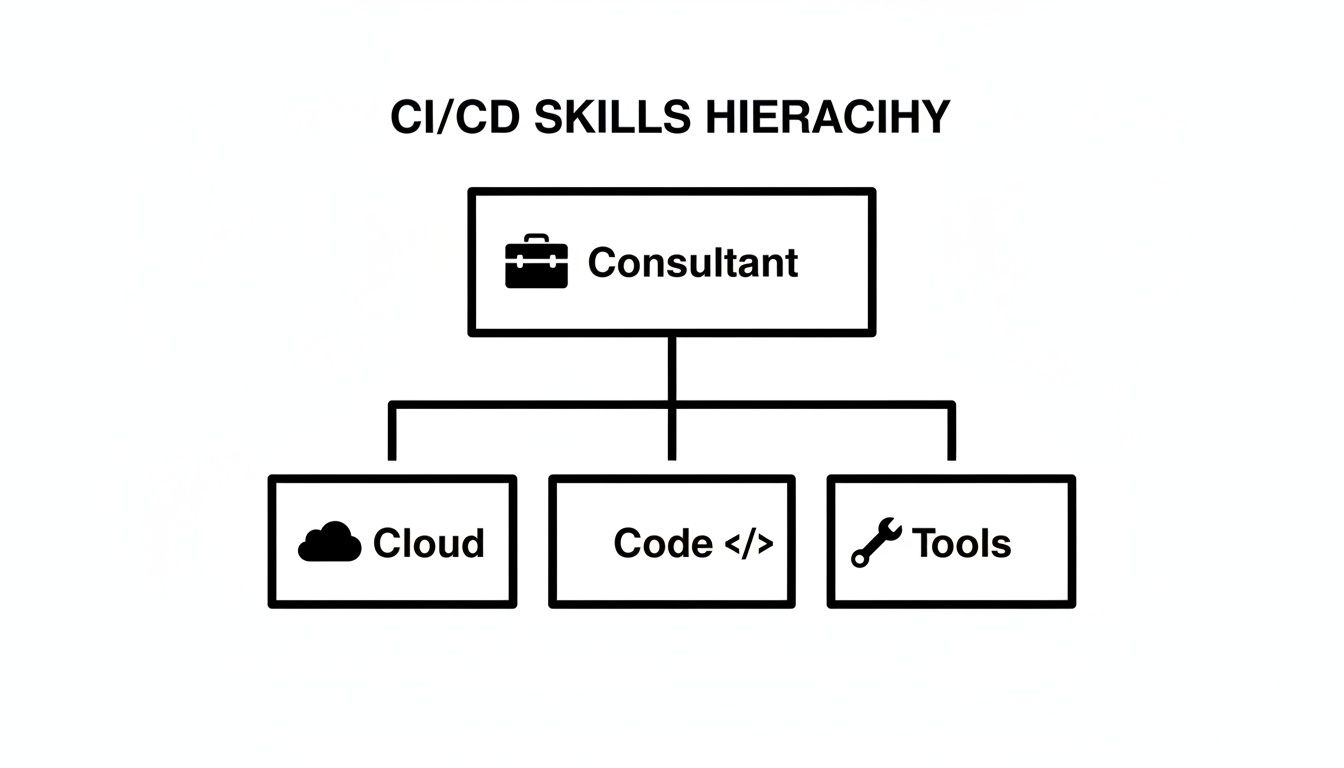
A consultant’s ability to solve these problems comes from a deep, multi-layered skill set.
Production Rollbacks Are a Regular Occurrence
If "release day" induces anxiety and deployments frequently result in production incidents requiring immediate rollbacks, your quality assurance process is reactive rather than proactive. Each rollback erodes customer confidence and diverts engineering resources to firefighting. This indicates that quality gates are either missing, ineffective, or positioned too late in the delivery lifecycle.
A high change failure rate is a direct measure of instability in the delivery process. It signals a lack of automated quality gates needed to detect and prevent defects before they reach production.
A consultant addresses this by "shifting left" on quality and security. They integrate a hierarchy of automated tests (unit, integration, end-to-end) as mandatory stages in the pipeline. Furthermore, they implement advanced deployment strategies like blue-green or canary releases, which de-risk the deployment process by exposing new code to a small subset of users before a full rollout. This transforms high-stakes releases into low-risk, routine operational events.
The Playbook for Hiring an Elite CI/CD Consultant
Sourcing and vetting an elite CI/CD consultant requires a strategy that goes beyond traditional recruiting channels. Top-tier practitioners are rarely active on job boards; they are typically engaged in solving complex problems. The hiring process must be designed to identify these individuals in their professional communities and to assess their practical problem-solving skills rather than their ability to answer trivia questions.
Sourcing Talent Beyond the Usual Suspects
To find elite talent, you must engage with the communities where they share knowledge and demonstrate their expertise.
- Open Source Contributions: Analyze contributions to relevant open-source projects. A consultant's GitHub profile—including their pull requests, issue comments, and personal projects—serves as a public portfolio of their technical acumen and collaborative skills.
- Specialized Slack and Discord Communities: Participate in technical communities dedicated to tools like Kubernetes, Terraform, or GitLab CI. The individuals who consistently provide insightful, technically deep answers are often the practitioners you want to hire.
- Conference Speakers and Content Creators: Those who present at industry conferences (e.g., KubeCon, DevOpsDays) or author in-depth technical articles have demonstrated not only deep expertise but also the critical ability to communicate complex concepts clearly.
The demand for this skill set is intensifying, especially in North America, which is projected to hold the largest market share of 51% by 2035 for CI/CD tools. This growth is accelerated by the rise of remote work, which increases the need for robust, automated delivery systems in distributed teams.
Scenario-Based Interview Questions That Reveal True Expertise
Abandon generic interview questions. Instead, use scenario-based problems that simulate the real-world challenges the consultant will face. The objective is to evaluate their diagnostic process, their understanding of architectural trade-offs, and their ability to formulate a coherent execution plan. For a deeper dive into modern hiring techniques, explore our guide on consultant talent acquisition.
Here are technical scenarios designed to probe for practical expertise.
Scenario 1: "You've inherited a CI pipeline for a monolithic application. The end-to-end runtime is 45 minutes, killing developer productivity. Detail your step-by-step diagnostic process and the specific technical changes you would consider to reduce this feedback loop."
A junior candidate might suggest a single tool. An expert CI CD consultant will articulate a methodical, data-driven approach.
What to Listen For:
- Investigation First: The answer should begin with targeted questions: "Is there existing telemetry or build analytics?" "Which specific jobs consume the most time: build, unit tests, integration tests?" "What is the underlying hardware for the CI runners?"
- Bottleneck Identification and Mitigation: They should describe a plan to instrument the pipeline to collect timing data for each stage. They will propose concrete technical solutions like:
- Parallelizing Jobs: Splitting a monolithic test suite to run in parallel across multiple runners.
- Optimizing Caching: Implementing intelligent caching for dependencies (e.g., Maven, npm) and Docker layers.
- Test Impact Analysis: Using tools to run only the tests relevant to the code changes in a given commit.
- Strategic Trade-Offs: An expert will discuss balancing speed and confidence. They might propose a tiered approach: a sub-5-minute suite of critical tests on every commit, with the full 45-minute suite running on a nightly or pre-production schedule.
Scenario 2: "Design a secure CI/CD pipeline for a new serverless application on AWS from the ground up. The design must include automated security scanning, and there must be zero hardcoded secrets in the pipeline configuration."
This scenario directly assesses their knowledge of cloud-native architecture and modern DevSecOps practices.
What to Listen For:
- Secure Credential Management: They should immediately reject hardcoded secrets and propose a robust solution like AWS Secrets Manager or HashiCorp Vault. They must explain the mechanism for the pipeline to securely retrieve secrets at runtime, for example, by using OpenID Connect (OIDC) with IAM Roles for Service Accounts (IRSA).
- Integrated Security Scanning: A strong answer will detail embedding security gates directly into the pipeline workflow. This includes:
- SAST (Static Application Security Testing): Scanning source code for vulnerabilities.
- SCA (Software Composition Analysis): Checking third-party dependencies against vulnerability databases.
- IaC Scanning: Analyzing Terraform or CloudFormation templates for security misconfigurations before deployment.
- Principle of Least Privilege: An expert will discuss permissions for the pipeline itself. They will describe how to create a granular IAM role for the CI/CD runner, granting it only the specific permissions required to deploy the serverless application, thus minimizing the blast radius if the pipeline were compromised.
Burning Questions About CI/CD Consulting
Engaging an external consultant naturally raises questions about engagement models, expected outcomes, and ROI. Clarity on these points is essential for a successful partnership.
What Do These Engagements Actually Look Like?
CI/CD consulting engagements are tailored to specific organizational needs and typically fall into one of three models:
-
Project-Based: A fixed-scope, fixed-price engagement with a clearly defined outcome (e.g., "Migrate our legacy Jenkins pipelines to GitLab CI" or "Implement a GitOps workflow for our Kubernetes applications"). This model provides cost predictability for well-defined objectives.
-
Retainer (Advisory): A recurring engagement providing access to a senior consultant for a set number of hours per month. This is ideal for teams needing ongoing strategic guidance, architectural reviews, and mentorship without requiring full-time implementation support.
-
Time and Materials (T&M): An hourly or daily rate engagement best suited for complex, open-ended problems where the scope is not yet fully defined. This flexible model is often used for initial discovery phases, complex troubleshooting, or projects with evolving requirements.
How Fast Will We See Results?
While cultural change is a long-term endeavor, a skilled consultant should deliver measurable technical improvements within weeks, not quarters.
A competent consultant prioritizes delivering a quick, high-impact win early in the engagement. This builds momentum and demonstrates the value of the investment. They will identify a significant pain point—such as an unacceptably long build time or a flaky deployment process—and deliver a demonstrable fix.
Within the first 2-4 weeks, you should be able to identify a specific, quantifiable improvement. A complete, end-to-end pipeline transformation may take 2-3 months, but progress should be incremental and visible throughout the engagement.
How Do We Know if We're Getting Our Money's Worth?
The ROI of CI/CD consulting should be measured using key DevOps Research and Assessment (DORA) metrics, which connect technical improvements to business performance.
- Lead Time for Changes: The time from commit to production. A decrease indicates accelerated value delivery.
- Deployment Frequency: How often you successfully release to production. An increase demonstrates improved agility.
- Change Failure Rate: The percentage of deployments causing a production failure. A decrease signifies improved quality and stability.
- Mean Time to Recovery (MTTR): The time it takes to restore service after a production failure. A lower MTTR indicates enhanced system resilience.
Track these metrics before, during, and after the engagement to quantify the direct impact on your engineering organization's performance.
Your Next Step Toward a High-Performing Pipeline
Achieving elite software delivery performance is an ongoing process of optimization, not a one-time project. A skilled CI CD consultant acts as a catalyst, transforming your delivery process from a source of friction into a strategic asset.
The primary objective is to accelerate innovation, improve quality, and empower your engineering team by removing operational toil. This investment shifts your organization's focus from reactive firefighting to proactive value creation. The right expert doesn't just implement tools; they instill a culture of continuous improvement that yields returns long after the engagement concludes.
The most powerful first step you can take is a clear-eyed self-assessment. Use the triggers we talked about earlier—like slow lead times or frequent rollbacks—to pinpoint exactly where the pain is in your delivery process.
Take Action Now
This internal audit provides the quantitative and qualitative data needed to build a strong business case for change. It establishes a baseline from which to measure improvement and helps define a clear mission for an external consultant.
Your next move is to translate these pain points into a focused, high-impact roadmap for improvement. If you need expert guidance building out that strategy, check out our specialized CI/CD consulting services. We help teams chart a clear path from diagnosis to delivery excellence, making sure every single step adds measurable value.
Ready to transform your software delivery process? OpsMoon connects you with the top 0.7% of DevOps talent to build the resilient, high-speed pipelines your business needs. Start with a free work planning session today.